
By Antonio
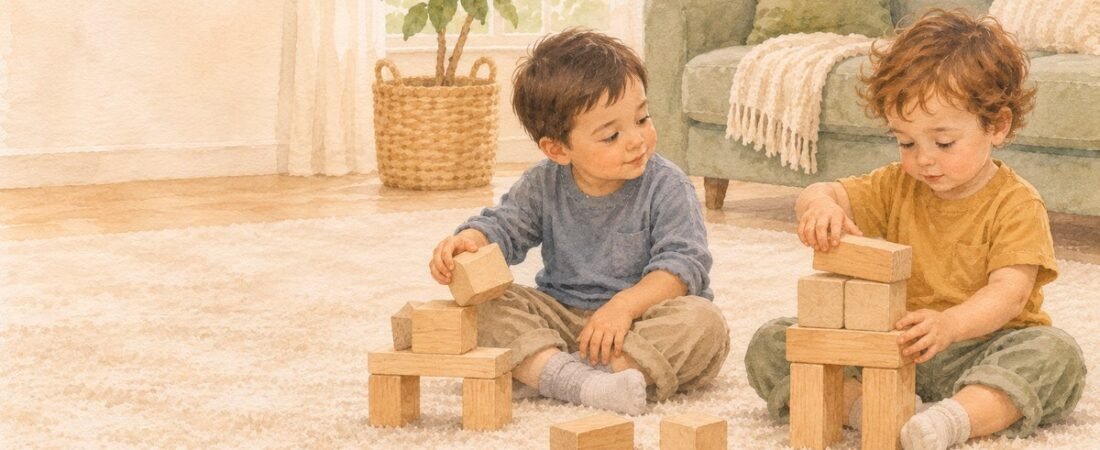
Toddlers have a special talent for sitting right next to another child while acting like they’re the only person in the room.
Give two of them some blocks and you might get two builders, two towers, and absolutely no interest in collaborating. One may copy the other, steal a quick look at what they’re doing, or suddenly decide their blue block looks much better in the other child’s hand.
It just so happens that I and my friends had a child around the same time. So when they all hit the 2-year-old mark, us parents agreed it’s time they play together (without sharing a word naturally). And when we brought them together? Well, my son bit the other kid because the other kid had a really cool car toy. A car toy that my son has never noticed although I got him the toy maybe 2 months earlier. Fortunately, at some point, they stopped arguing and each kind of did their own thing.
It can look a little strange if you’re expecting “playing together” to actually involve playing together.
There’s a name for this stage of almost-but-not-quite-together play: parallel play.
Little Moment Play
Should I Step In?
Two toddlers playing nearby? Choose what’s happening and see one small thing you can do, or when it’s better to leave them to it.
One small next step.
Choose the closest situation. You can change it whenever the play changes.
You don’t have to turn every playdate into a shared game.
They’re playing separately and seem happy.
Leave a good moment alone.
- What to do
- Stay nearby and supervise. Let each child carry on with their own play; there’s no need to turn it into a shared game.
- What you could say
- Nothing needs to be said. Respond if a child starts a conversation or asks for help.
- When to step in
- Help if either child is distressed, unsafe or clearly needs assistance.
- If that doesn’t help
- If play changes, respond to what’s happening now. You don’t need to keep a good moment going by directing it.
One child is just watching.
Let them watch.
- What to do
- Put a few familiar toys within reach, without asking the child to join. Let them choose whether to watch, play or move closer.
- What you could say
- “There are some blocks here if you’d like them.”
- When to step in
- Help if the child is upset, seeks your support or the situation becomes unsafe. Watching alone doesn’t call for an intervention.
- If that doesn’t help
- If they seem uncomfortable or lose interest, offer a familiar activity elsewhere and go with them.
They both want the same toy.
Solve the toy problem.
- What to do
- Acknowledge that both want it. Let the child using it keep their turn, and offer a similar toy to the child waiting.
- What you could say
- “You both want that truck. It’s being used right now. Here’s another car we can try.”
- When to step in
- Move close if grabbing escalates or either child becomes distressed. Stop any hitting or pushing immediately.
- If that doesn’t help
- If another toy doesn’t help, help the waiting child start a separate activity nearby. Don’t take the first toy away to force sharing.
One wants to join, but the other doesn’t.
Make room for both children.
- What to do
- Keep the first child’s play intact. Give the interested child materials and a spot alongside, so joining in doesn’t mean taking over.
- What you could say
- “You can build your tower here next to them.”
- When to step in
- Help if a child’s space or materials keep being taken over, or either child is upset. Step in immediately if anyone is unsafe.
- If that doesn’t help
- Offer an activity that doesn’t depend on the other child joining. They can connect later if both show interest.
They keep disrupting each other’s play.
Give their play more space.
- What to do
- Check safety first. Help create more space between the activities and put enough similar materials within reach of both children.
- What you could say
- “Let’s make some room so both towers can stay up.”
- When to step in
- Stop hurting, hitting or pushing immediately. Otherwise, help when repeated collisions or interruptions are frustrating either child.
- If that doesn’t help
- Pause this activity and help them settle into separate play areas nearby, with materials that are less likely to clash.
What Is Parallel Play?
Parallel play is when children play near each other while still following their own separate play. They may use similar toys, watch or copy one another, and occasionally interact, but they aren’t organizing the activity around one shared idea or goal.
HSE’s stages-of-play guidance gives a very simple example: two children sitting side by side colouring, or building separate towers from blocks. NAEYC uses a similar example of two children at a water table beside one another without actually using the materials together.
Real play can be a little messier than the definition, though. A toddler may glance over at what another child is building and decide to try the same thing. NAEYC’s guidance on toddler block play notes that toddlers playing near one another often watch how a peer uses materials and imitate what they see.
So I wouldn’t use “they don’t interact” to mean the children somehow don’t know the other person exists.
The easiest way I’ve found to think about it is this: Are they sharing the space, or are they sharing the game?
If they’re sharing the space while each child is still deciding what happens in their own play, parallel play is a reasonable description.
What Age Does Parallel Play Start?
This is where the nice, tidy definition gets less tidy. Based on my research at least.
The Canadian Paediatric Society says children usually begin taking part in parallel play around 12 to 18 months. HSE’s broader stages-of-play guide says parallel play usually happens between ages two and three, while Pathways uses two years and older as its broad guide.
I wouldn’t try to turn those into one supposedly correct starting birthday.
Different guides are describing broad developmental patterns, and children don’t all move through them on the same schedule. HSE itself notes that every child is different and can go through the stages at different times.
A more useful way to read the ages is that you may begin seeing side-by-side play during the second year of life, while the classic version becomes particularly easy to recognize during the toddler years. So if your two-year-old happily plays beside another child without creating one shared game, that fits very comfortably with the descriptions in these guides.
The same goes in the other direction. I wouldn’t expect a child to reach their third birthday, receive an invisible certificate for completing parallel play, and never do it again.
The ages are guides. The play in front of you is usually messier.
When Does Parallel Play End, and What Comes Next?
As you might expect, there isn’t a clean finish line.
Descriptions of social play commonly move from playing alone and watching other children into parallel play, then associative play and cooperative play.
HSE describes associative play as children playing around one another and interacting while still having different ideas and goals. Cooperative play goes further: the children begin working toward something together.
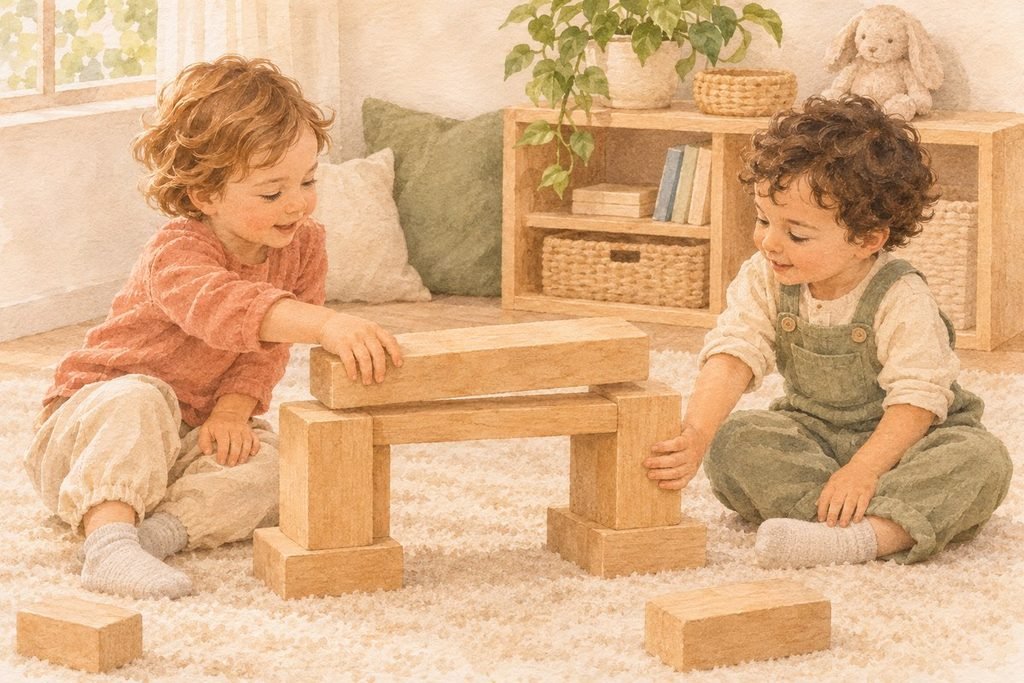
You can see the distinction with the same pile of blocks. Two children making separate towers beside one another fit parallel play. If they’re talking, exchanging blocks and paying more attention to what the other child is doing while still building their own things, the play starts looking more associative.
If they decide to build one giant castle together and begin negotiating where the door goes, we’re much closer to cooperative play.
HSE gives broad age ranges of three to five for associative play and four to six for cooperative play, but also makes clear that children develop at different times. I find the categories more useful as descriptions of what is happening than as levels a child is supposed to complete on schedule.
Apparently even play needs a progression system. Toddlers, thankfully, have not read the manual.
Parallel Play vs Other Types of Play
The terminology becomes easier once you stop trying to memorize every stage and look at what the children are actually doing.
| Type of play | What it can look like |
|---|---|
| Solitary play | A child plays independently and is mainly focused on their own activity. |
| Onlooker play | A child watches other children playing without joining them. |
| Parallel play | Children play near each other but continue with separate activities or ideas. |
| Associative play | Children interact or exchange materials, but don’t organize everything around one shared goal. |
| Cooperative play | Children organize the play together around a shared idea, role or goal. |
The table makes those boundaries look much cleaner than they usually are.
A child can watch for a while, move closer, copy something another child is doing, return to their own activity, and later join in. I wouldn’t spend a playdate mentally moving them between categories every thirty seconds.
The names are useful when they help us understand what we’re seeing. After that, we can probably go back to watching the kids.
Do I Need to Get Them to Play Together?
Probably not.
If two toddlers are content playing beside each other, I wouldn’t turn the moment into a teamwork exercise just because they happen to be in the same room.
HSE’s advice on parallel play is unusually straightforward: don’t force children to play together. Playing with other children comes with time.
That is useful because I think there is a very parent-like temptation to help a little too much. Two children have blocks, so we suggest they build something together. Then we decide whose block should go where, encourage them to share, solve every disagreement and somehow become project manager of a tower neither child asked us to build.
You can help if there’s a problem. You can join if they invite you. But if both children are happily doing their own thing beside one another, the absence of a shared plan isn’t necessarily a problem that needs fixing.
The same applies to sharing. The Canadian Paediatric Society notes that toddlers are still learning to share and recommends putting out toys with multiple similar items, such as vehicles, blocks and play food, during early playdates.
That feels much more realistic to me than putting one incredibly exciting truck between two toddlers and hoping they use the opportunity to demonstrate advanced diplomacy.
Sometimes the easiest answer really is another truck.
How I’d Set Up Parallel Play
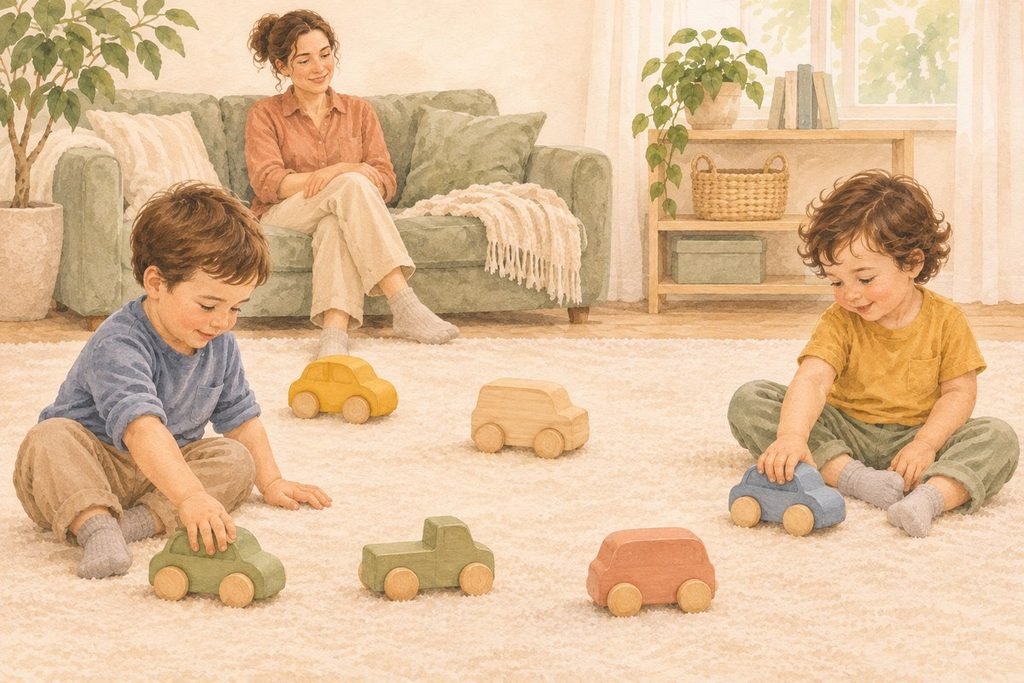
A couple of times I tried to set the “playing field” for parallel play, just to see what happens. Here’s what worked best for me:
One time, I decided to put my impressive collection of blocks to good use. I made two little building areas on the living room floor, with enough blocks for my son and another toddler to build whatever they wanted. I thought I’d been clever. Two piles of blocks, two children, no reason to fight over anything.
And for a while, it worked. They each built their own towers, brought them down, occasionally looking over to see what the other was doing. I was quite pleased with myself until one of them spotted a block in the other child’s pile. Apparently, that particular block was far superior to the twenty identical ones lying around.
So much for my brilliant setup.
But they were perfectly happy playing beside each other without my help. I didn’t need to suggest a shared castle or organize a construction team (a construction team called “Dad”).
So my suggestion is to start with something they can each control.
The Canadian Paediatric Society’s advice about using multiple similar toys fits this well. You’re removing an avoidable source of conflict before asking two toddlers to deal with it.
Space matters too. Parallel play means near each other, not elbow to elbow. If every movement knocks down the other child’s tower, the setup has created a problem the children now have to solve.
Then, once they’re doing something, I’d try not to improve it to death.
You can notice what is happening without deciding what should happen next. “You both chose cars” leaves the play where it is. “Why don’t you race them?” introduces a new idea. Maybe they’ll love the race. Maybe you’ve just interrupted two perfectly happy toddlers.
Easy Parallel Play Ideas to Try
You don’t need to buy a special parallel-play toy. The easiest options are ordinary activities where two children can do something similar without depending on each other.
Blocks are the simplest place to start. Give both children access to enough pieces and let them build separately. If one begins copying the other’s tower, there is no need to turn the copying into a lesson.
Cars work for the same reason. Several vehicles and a patch of floor give both children something to control. Their routes may cross. They may start copying noises. One may eventually decide the other person’s car is clearly superior. All normal toddler possibilities.
For drawing, give each child their own piece of paper and put enough washable crayons within reach. They can sit at the same table and notice what the other person is doing without having to collaborate on one masterpiece.
Play dough works if each child gets their own portion. The same idea applies to sand or sensory play: enough containers, scoops or tools that being beside another child doesn’t automatically mean waiting for whatever they’re holding.
Toy animals, dolls and pretend food can work too. One child might start feeding a toy while another creates a completely different game beside them. If those two games eventually collide and become one, great. They don’t have to.
I would choose from whatever the children already like rather than worrying about whether an activity is officially a “parallel play activity.”
The blocks aren’t the important part. The useful bit is that each child has something they can control while another child is close enough to notice.
What If My Child Mostly Watches Other Children?
Then they may be doing exactly that: watching.
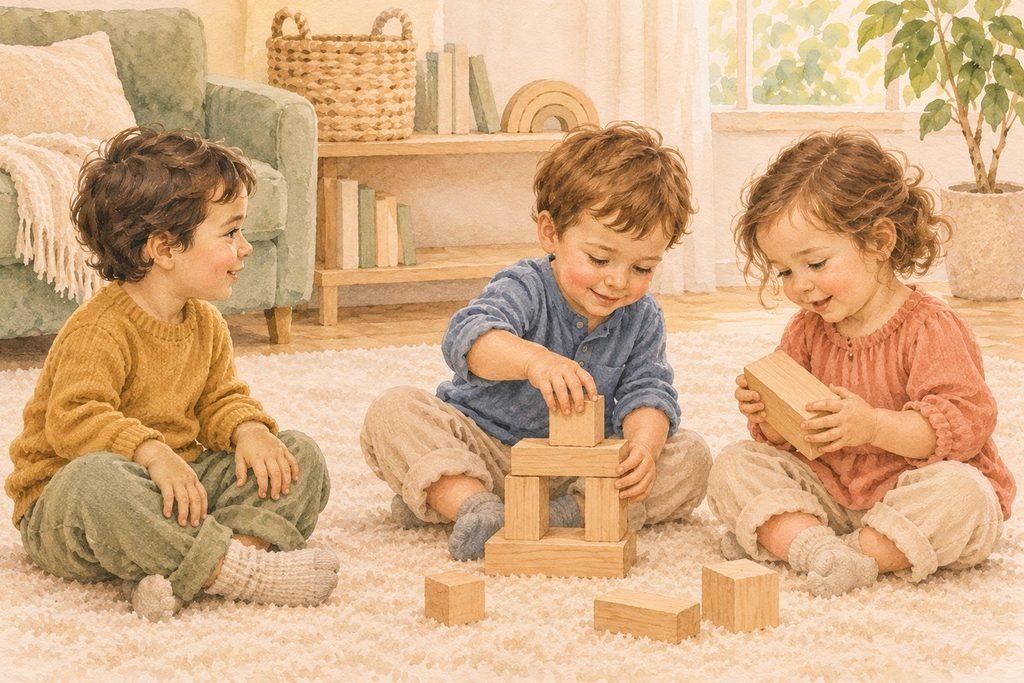
Onlooker play is another commonly described form of early social play. HSE describes it as a child watching other children play without joining and calls it a normal, healthy part of development.
That can be difficult to leave alone as a parent because another child is right there. Surely we’re supposed to encourage them to go over and play?
I wouldn’t assume so. Watching gives a child time to understand what the other children are doing. If they want to move closer, copy something or join later, they can. You can make that easier by leaving familiar toys or materials nearby, especially something they can use without needing permission from the other child.
What I wouldn’t do is repeatedly ask, “Do you want to go play with them?”
They know the other children are there. Watching might simply be what they want to do right now.
Is Parallel Play Something to Worry About?
Parallel play itself is described by HSE, the Canadian Paediatric Society, Pathways and other early-childhood sources as a normal part of young children’s play.
So I wouldn’t treat a toddler playing beside another toddler as evidence that something is wrong. I also wouldn’t use one playdate as a developmental test. Children can behave differently at home, around siblings, with children they know well, with strangers, or in a loud unfamiliar place. One snapshot tells us very little about the whole child.
If what is worrying you is not really the parallel play but a broader pattern involving your child’s communication, interaction or development, that’s a different question and one worth discussing with an appropriate healthcare professional.
For the much simpler situation, where you’ve watched two toddlers apparently ignore one another while doing almost the same thing, the explanation may be exactly what it looks like:
They’re playing beside each other. For now, that can be enough.
How I Researched This Guide
I treated this as a research-informed parenting guide rather than a developmental assessment.
For the basic definition and stages, I compared HSE’s stages-of-play guidance, the Canadian Paediatric Society’s guidance for play during the second year of life, Pathways’ overview of the stages of play, and NAEYC material explaining social and parallel play.
The age ranges don’t line up perfectly. Rather than choose whichever number gave me the cleanest answer, I’ve kept that uncertainty visible. These sources are useful for understanding the pattern, but I don’t think parents gain much from turning a broad developmental stage into a deadline.
For the practical setup, the Canadian Paediatric Society’s advice about using multiple similar items during toddler playdates was particularly useful. NAEYC’s toddler block-play guidance also describes children watching peers and imitating how they use materials, which is a good reminder that side-by-side play isn’t necessarily socially empty just because the children aren’t running one game together.
That’s probably the idea I’d keep from all of this.
Two toddlers can look like they’re ignoring each other while still noticing, learning from and getting used to another child being part of the play space.
Sometimes our job is to help. Sometimes it’s to provide enough blocks and get out of the way.
For more on how toddler play changes, you can also read my guide to pretend play and my guide to independent play.
If you’re looking for something practical to put in front of them, you can also browse my activities for 2-year-olds or my activities for 3-year-olds.
Looking for something to play next?
Find something that fits your child’s age, your setup time, mess tolerance, and the kind of moment you’re dealing with.