

By Antonio
When my son was around two, we saw a mother and her child playing shop at a playground. I decided to try it with him. He became the shopkeeper, and I bought imaginary chocolate, counting imaginary money into his hand with a touch for each count. He then ate the money.
“Don’t eat money!” I said, exaggerating my reaction. Naturally, he didn’t listen. Instead, “eating money” became part of the game. He would eat his “hard-earned cash”, look at me with a grin, and wait for me to object. We still return to that joke when we play pretend.
So as part of the article, I did some research on pretend play.
Simple pretend actions can appear during the second year, around 12–18 months, with play becoming more elaborate as children grow. Early examples can be much smaller than a whole game of shop: pretending to drink from an empty cup or feeding a doll count. The Illinois Early Learning Guidelines on symbolic thought describe these early actions and later examples involving familiar routines and substitute objects.
The useful question, then, is both when it starts and what we’re looking for. You don’t need to classify every moment to enjoy playing together, but understanding a few examples can help you recognize what your child is doing and find a way to join in.
Quick note, I’m just a dad interested in everything parenting-related, so don’t take this at face value. Here I’ll present my research and thoughts. If you’re up for it, let’s begin.
 Little Moment Play
Help me get a little pretend play going
If your child hasn’t shown interest in pretend play, start with one small invitation. Choose something you have nearby for a small game you can share.
With an empty cup
Try this
Lay the cup on its side. Whisper, “Shh, the cup is asleep,” and give one quiet snore.
Invite them in
Lean towards the cup together: “Shall we say good morning?” Say it once yourself, then see whether they want to join you.
If they engage
If they tap the cup, make it wake with a little “Oh! Hello.”
If it doesn’t catch
Leave the cup available for ordinary play. No need to repeat the performance.
Use an empty, unbreakable cup, an age-appropriate soft toy, or an open box without staples or loose parts.
What counts as pretend play?
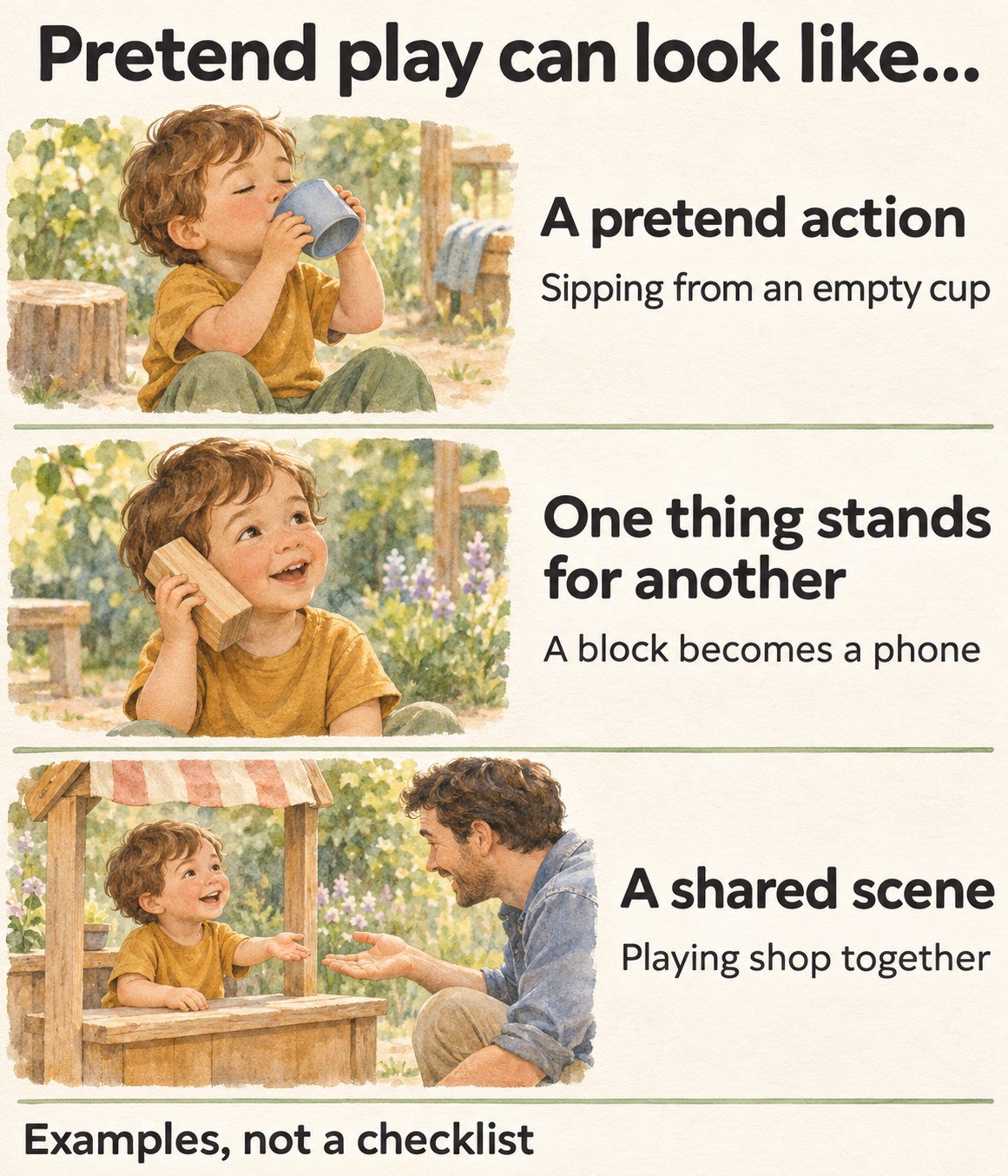
Pretend play involves acting as though something is happening that isn’t happening, or letting something stand for something else. An empty cup can contain pretend tea. A doll can be hungry. A block can become a phone. We all know that.
These are examples of the symbolic thinking described in the Illinois Early Learning Guidelines on symbolic thought. Your child doesn’t need to announce a story or assign everyone a character for there to be something to notice.
It helps to pay attention to the action rather than the toy’s label. A toy kitchen creates an opportunity for pretending, but owning one doesn’t tell you what a child is doing with it. They might be opening and shutting its doors, exploring the knobs, or serving you an imaginary meal. Those are different ways to play with the same object.
With my son, neither the chocolate nor the money existed. We were giving meaning to gestures between our hands. I suspect he first ate the money because he thought that was chocolate too, although I can’t know what he was thinking. What I could see later was the grin: he would repeat the action and look at me for the familiar response.
I wouldn’t use that moment to make a claim about his development. It does show why a description such as “playing shop” can miss the part that matters to the people playing it.
When pretend play starts—and why age guides differ
There isn’t one age that captures every form of pretend play. A brief pretend sip, feeding a toy, and keeping a shop going with another person ask different things of a child.
Research also looks at particular tasks rather than every possible moment at home. In Nielsen and Dissanayake’s study of pretend play in the second year, researchers followed 98 infants from 12 to 24 months. The abstract reports the emergence of pretend play between 18 and 21 months in that study. That gives us evidence about the children and tasks studied, rather than a deadline for every child.
The CDC’s guidance makes another distinction worth understanding:
- The CDC parenting tips for 18-month-olds suggest taking turns pretending to feed a stuffed animal. This is an activity suggestion, rather than an item on that page’s milestone checklist.
- The CDC milestone checklist for 30-month-olds includes using an object to represent something else, such as treating a block as food for a doll.
The CDC defines its milestones as things at least 75% of children can do by a given age. A milestone listed at 30 months therefore doesn’t mean that skill first appears at 30 months.
You may also see guides describing imaginative play as starting between two and three. ZERO TO THREE’s guide to imaginative play at ages two to three uses that wording in a guide that discusses connected routines, such as feeding a doll, rocking it, and putting it to bed. The sources don’t all describe the starting point in the same way, so I’d read the example alongside the age. A pretend action lasting a few seconds and an unfolding scene are both relevant, but they aren’t identical expectations.
How a small pretend moment becomes a game
I don’t know whether the playground shop was my son’s first pretend game. It’s one I remember because it became ours. I never did think too much about pretend play with my kid until it began.
I introduced the setup after seeing another family play. He joined in, then took it somewhere I hadn’t planned. I was buying chocolate; he was eating my payment. Once he knew the response that would get, repeating it became part of the fun.
For me, that is the useful parenting detail in the story. Introducing an idea didn’t mean I had to decide how it should unfold. I could give him something to respond to and then respond to what he contributed.
That doesn’t mean every unexpected action needs a developmental explanation. I don’t need to know exactly when eating the money became a deliberate joke to recognize that he enjoyed getting me involved. The shared game was worth having without resolving that question.
Ways to join in without running everything
I would start with something your child already recognizes: drinking, eating, shopping, putting someone to bed. Familiar routines give you something to act out without explaining a whole imaginary world. ZERO TO THREE’s guidance on following a child’s pretend play recommends letting children choose the play and building on what they are doing.
For an invitation, I’d choose one action. Take a pretend sip from an empty cup, then offer it. Tuck a stuffed animal under a blanket, then leave room for your child to respond. Those are suggested starting points, rather than activities I’m claiming to have tested with every child.

Once something catches their interest, you can stay with it. If they offer another drink, accept it. If the animal needs waking up again, join that version. You don’t have to add a new character or a problem to solve each time the play repeats.
Questions can help, but I wouldn’t make every turn a question. “What are you cooking?” gives a child an opening; several questions about ingredients, customers, prices, and what happens next can leave them doing most of the answering while you decide the game. Sometimes taking the offered cup gives them more room.
If your child starts directing what happens, follow the part they give you. The American Academy of Pediatrics’ HealthyChildren guidance on encouraging pretend play also encourages allowing children to lead their imaginary scenarios and turn to adults when they want help or ideas.
If they walk away or use the objects differently, I’d let that attempt end. You can offer another opportunity later without trying to extract a pretend response now. One invitation is a chance to play together, rather than a reliable assessment of what a child can do.
And if they find something funny, you can enjoy that part. My son didn’t need a more realistic shop. He had a customer who kept handing over edible money.
How I researched this guide
The playground shop story is my experience with my son at around two. My explanation of why he first ate the imaginary money is my interpretation.
For the developmental guidance, I compared the CDC’s 18- and 30-month pages, the Illinois Early Learning Guidelines on symbolic thought, and ZERO TO THREE’s guidance for ages two to three. I also consulted the abstract and available results summary of Nielsen and Dissanayake’s longitudinal study, alongside the American Academy of Pediatrics’ guidance on joining pretend play.
I used those sources to distinguish early actions from more elaborate play, rather than create a timetable for parents to test against.
The next time you notice a possible pretend moment, you can respond to what your child offers. Accept the drink, join the shop, or take the role they give you. You can understand more about their play while still leaving room for them to surprise you.
For more ways to support your child’s play, explore these guides:
Looking for something to play next?
Find something that fits their age, your setup time, mess tolerance, and the kind of moment you’re dealing with.