
By Antonio
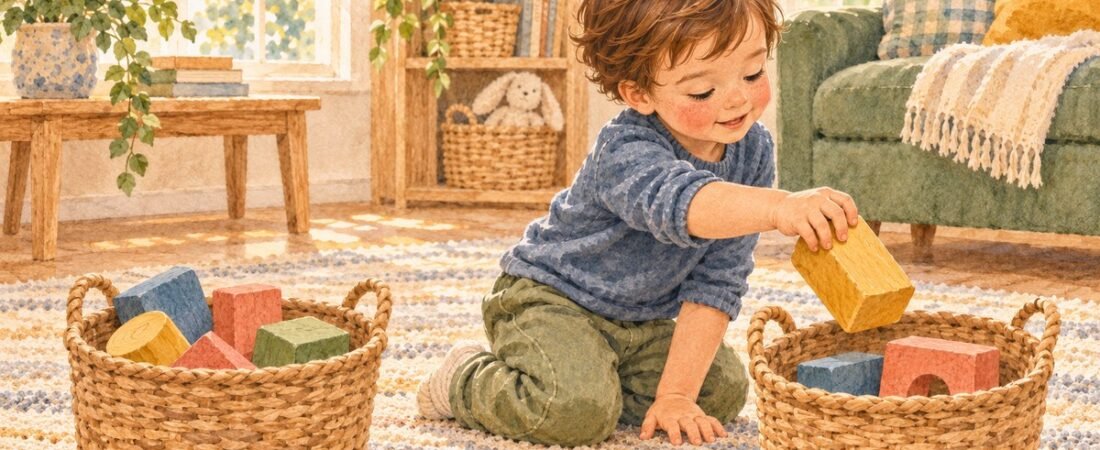
My son loves to carry blocks from the living room into the bedroom and just leave them all over the floor for me to step on them. So I put them back. While doing my part, I can almost feel him watching me. So when I clean it all up, he starts another chaotic delivery. Apparently, I have a very committed logistics manager.
I like to ponder what the fascination is. After all, there are dozens of things he could be doing, but he chose the blocks.
There may be more going on than meets the eye. Some of these repeated behaviors fit patterns that early-childhood educators call play schemas.
So I did some dad-level research to help myself and you out. Understanding them can give us a few useful ideas about what to offer our children, without turning every play session into a lesson.
What Are Play Schemas?
So, what are play schemas?
Play schemas are repeated patterns of behavior that children may show while exploring how things work. A toddler might repeatedly drop objects, move toys from one place to another, wrap things in fabric, or arrange objects in a particular order.
The key element isn’t one particular action. It’s the repeated interest behind it. Here’s another example I noticed with my son:
This autumn there have been a lot of leaves in our street. More than usual. So now every time we go home from kindergarten, he needs to do his diligent duty of carrying leaves from one place to another. There’s no way we’re getting into the house before he does that.
Different materials, but a similar pattern of play.
Education Scotland’s guide to play schemas describes these repeated actions as ways babies, toddlers, and young children explore their surroundings and try to understand how things work. Some children show one especially noticeable pattern, others show several, and some may not display a particularly obvious schema at all.
The idea has a history in early-childhood education. Psychologist Jean Piaget explored how children build knowledge through experience, and educator Chris Athey later developed work on repeated patterns in children’s play. The Open University’s explanation of schema theory provides a useful introduction to that background.
For parents, though, I think the theory is most useful when it helps answer a practical question: what is my child so interested in doing, and can I give them a safe way to explore it?
That’s more manageable than trying to become an expert in developmental psychology before breakfast.
Little Moment Play · A practical play adjustment
Keep the Interest,
Change the Setup
Start with what your toddler keeps doing. Find one change to try, then work out what to do next.
This tool needs JavaScript to show a tailored setup. If it does not load, use the article’s activity ideas. Stop unsafe play first and stay with your toddler.
- 1 · Notice
- 2 · Choose the challenge
- 3 · Try & adjust
The 9 Common Play Schemas (With Toddler Examples)
Per my research, you’ll sometimes see articles describing eight play schemas and others describing nine. That’s because different early-years resources group and name these patterns differently, not because there’s one universal list that everyone must follow.
For this guide, I’m using nine commonly described patterns. Medway Early Years’ overview of schemas describes all nine, while other educational resources group some differently.
Here’s what they look like in everyday toddler play.
| Play schema | What you might notice | A simple activity to try |
|---|---|---|
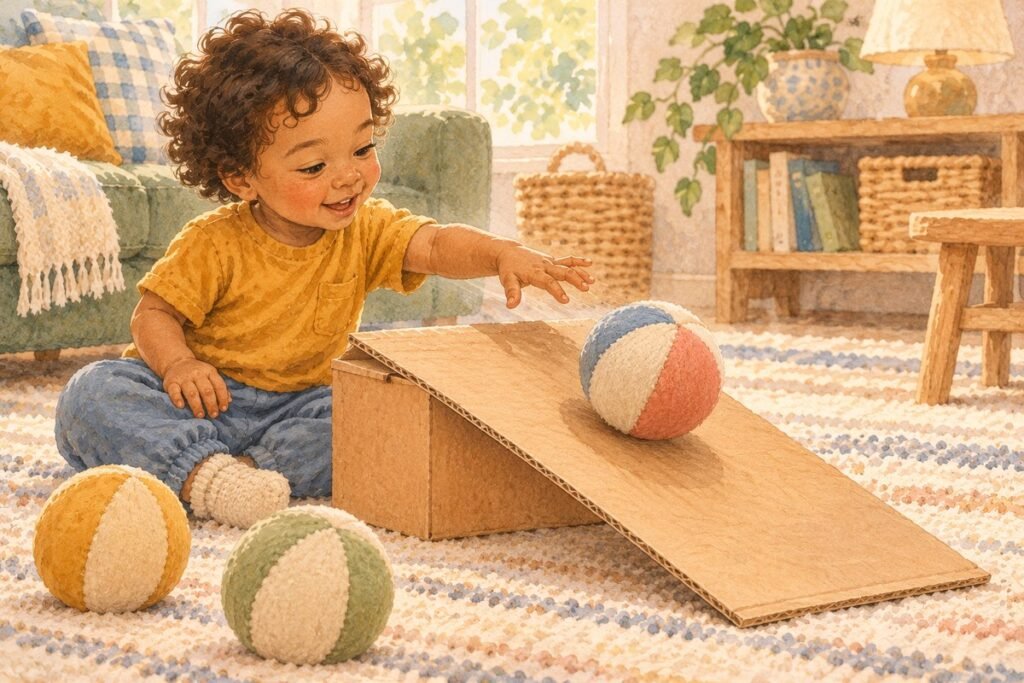
| Trajectory | Dropping, rolling, throwing or watching things move | Roll large soft balls down a low ramp |
| Transporting | Carrying objects from one place to another | Move large blocks between two baskets |
| Connecting | Joining objects together and pulling them apart | Build with large interlocking blocks |
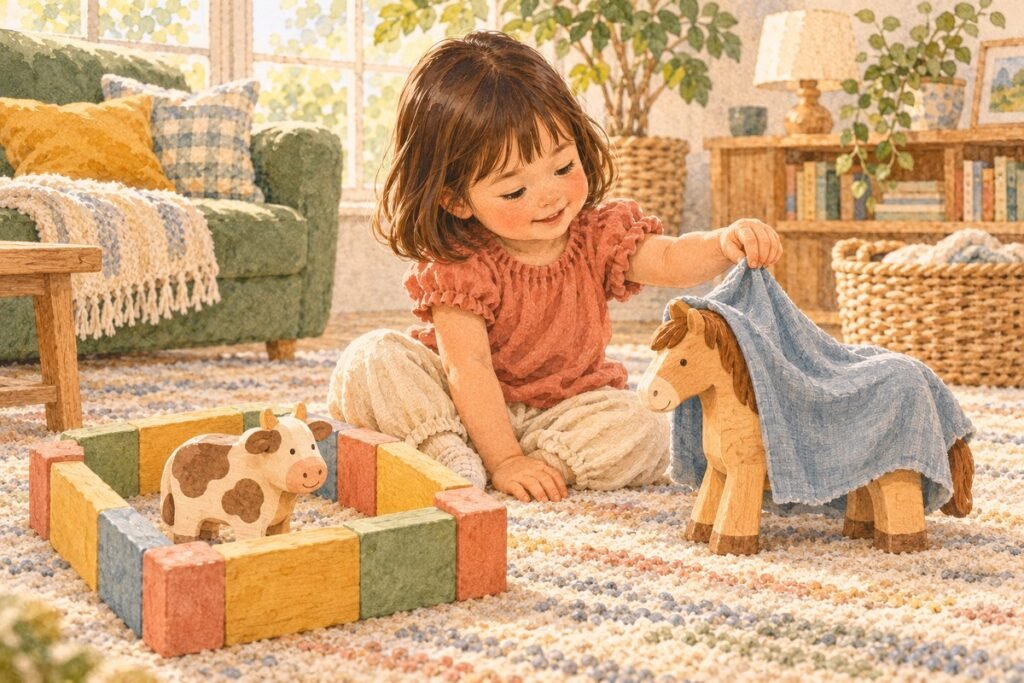
| Enclosing | Creating boundaries or putting things inside an area | Build a fence around large toy animals |
| Enveloping | Covering, wrapping or hiding objects | Wrap and unwrap a large doll with a lightweight cloth |
| Rotation | Spinning wheels, turning objects or exploring circular movement | Spin the wheels of a large toy vehicle |
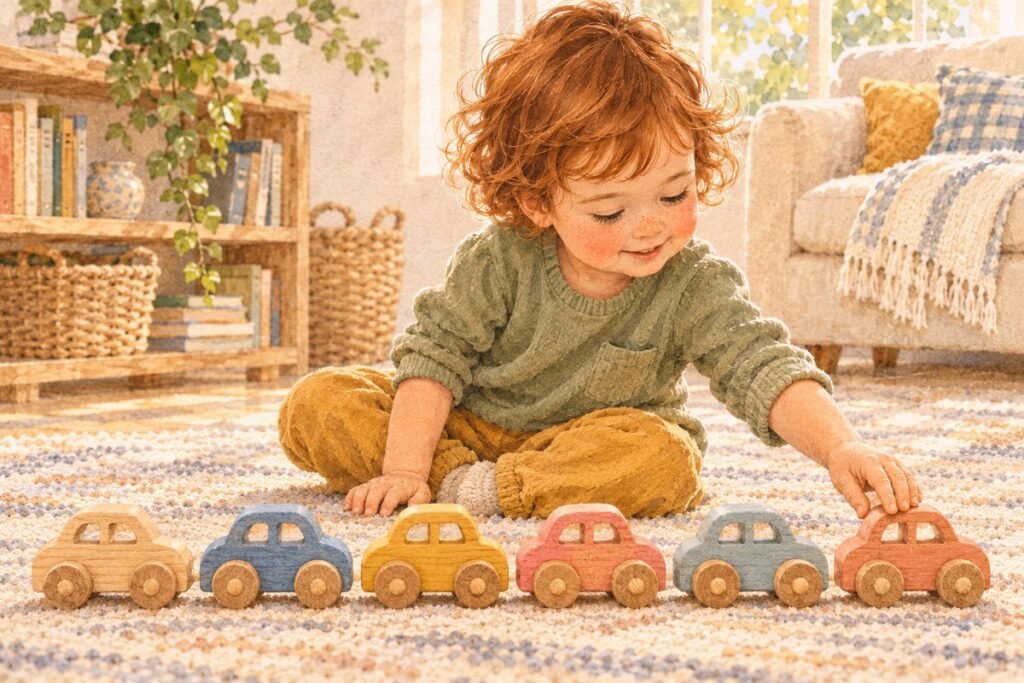
| Positioning | Lining up, arranging or carefully placing objects | Arrange large toy cars in a row |
| Orientation | Exploring different positions and viewing angles | Look through a short, stable play tunnel |
| Transforming | Changing the shape or appearance of materials | Squash and reshape age-appropriate play dough |
These are examples, not tests. A child doesn’t need to show every behavior in the table, and an activity can involve more than one pattern at the same time.
There are also a few distinctions worth understanding because some schemas can look quite similar.
Enclosing vs. enveloping
These two are easy to mix up.
Enclosing is about creating or exploring a boundary. Imagine a toddler using blocks to build a little wall around their toy animals, or placing several toys inside a large box.
Enveloping involves covering or wrapping something. The same child might hide those animals under a cloth or wrap a doll in a blanket.
In one case, they’re creating an area around an object. In the other, they’re covering it.
The difference is useful when choosing materials, but I wouldn’t interrupt a child who’s happily playing just to work out which label is technically correct.
Trajectory vs. transporting
Both can involve moving objects, but the interests are somewhat different.
Trajectory play is about movement itself. A child repeatedly watches a ball roll down a slope or drops an object to see where it lands.
Transporting is about taking things from one place to another. The child might spend a surprising amount of time collecting toys, loading them into a basket, and delivering them to the other end of the room.
Of course, a toddler carrying cars across the room and then rolling them down a ramp may be exploring both patterns.
That’s perfectly fine. The categories are meant to help us notice interests, not divide every toy into nine separate departments.
Positioning, connecting, and rotation
A toddler lining up five cars in a perfect row may be showing an interest in positioning. A child repeatedly attaching and detaching pieces of a track may be exploring connecting. Someone endlessly turning the wheels of a toy car may be more interested in rotation than in driving the car anywhere.
The same toy can support all three.
That’s one reason I wouldn’t recommend buying a separate set of toys for every schema. Ordinary materials already offer plenty of possibilities, and children’s interests don’t stay neatly within the categories.
How to Recognize Your Toddler’s Play Schemas
The best place to start is simply watching what your child chooses to do when nobody is telling them how to play.
Not in a formal observational session, obviously. You can just pay attention while they’re playing with the things they already have.
Maybe your toddler always wants to carry things. Blocks go into a basket, soft toys go into a bag, and every object apparently needs transporting to another room. Or perhaps the repeated interest is arranging. Their cars end up in long lines, their blocks are grouped together, and they’ll occasionally rearrange something you’ve put down.
One important clue is whether a similar interest appears across different activities.
Education Scotland’s schematic play guidance recommends observing what children repeatedly choose to do and offering environments that help them explore their interests.
I’d also pay attention to what happens when you offer something slightly different.
Suppose your child keeps lining up cars. You put a few chunky blocks nearby, and they start arranging those in a row too. That makes the repeated interest easier to notice. But if they ignore the blocks and return to the cars, that doesn’t mean you’ve discovered anything wrong with your theory.
It might just mean they wanted to play with cars.
The point isn’t to keep experimenting until you’ve successfully classified your toddler. It’s to notice what seems to interest them and use that information when choosing what to offer next.
And one behavior on its own tells us very little. Throwing a toy once doesn’t establish a trajectory schema, just as liking a particular arrangement doesn’t automatically tell us anything about a child’s broader development.
I’d treat schemas as clues, not labels a child needs to earn.
How to Support Play Schemas at Home
This is the part I find most useful.
Once you have some idea of what your toddler enjoys repeating, you can make that kind of play easier, safer, and more interesting without needing to explain schemas to them.
Keep the approach simple: notice the interest, offer something that fits it, and let the child decide what happens next.
Start with what they’re already doing
Let’s say your toddler loves moving objects between containers.
You could put a few large blocks in a basket and place another basket a short distance away. Rather than immediately announcing an activity, you might move one block yourself and see whether your child wants to continue.
If they start transporting the blocks, great. There isn’t much else to organize.
They might move every block into the second basket, then bring them all back. Or they might decide the baskets are more interesting as hats.
The activity doesn’t need to follow your plan to be worthwhile. This is a useful difference between providing an opportunity and trying to teach a child a particular way to play.
Give the child control of the interesting part
Consider a toddler who’s fascinated by things rolling.
You could make a simple low ramp from a sturdy piece of cardboard and offer a large, age-appropriate ball. Roll it once so your child sees what it does, then leave the materials available.
If they start experimenting with different positions or repeatedly sending the ball down the ramp, I’d resist the temptation to add too many instructions.
It’s easy to start asking which ball is faster, where the ball will land, whether they can count the rolls, and how many colors they’ve spotted along the way.
None of those questions is automatically bad. But the child may already have a perfectly good question of their own: what happens if I roll this again?
ACECQA’s guidance on play-based learning emphasizes children’s ability to make choices about their play, alongside thoughtful adult support.
For me, that’s a good reminder that getting a child interested and letting them take over are two different jobs. Sometimes the second job is to stop doing the first one.
Change the materials, not necessarily the interest
Some repeated behaviors can drive parents slightly mad. Transporting is a good example.
If your child is constantly emptying drawers and carrying their contents around the house, I wouldn’t assume the only two options are letting the chaos continue or stopping the behavior completely.
You could provide a basket of safe, large objects specifically for carrying and moving. The child still gets to transport things, but the items are now ones you’re happy to see travelling through the living room. Similarly, if they’re fascinated by positioning, you don’t need to protect your carefully arranged bookshelf from becoming their next project. Offer large cars or blocks on a low table where they can create their own arrangements.
For transforming, you could provide a small amount of age-appropriate play dough and let them squash, flatten, roll, and reshape it, with supervision. These activities don’t have to be complicated. In fact, I’d start with the simplest version and only add materials if the child seems interested in them.
What if they’re not interested?
Then I’d stop trying to make that particular activity happen.
This is an easy trap with any researched parenting idea. You’ve learned about a schema, found a clever activity, gathered the materials, and now you’re understandably hoping the toddler will appreciate your preparation.
The toddler, meanwhile, has found a cardboard box. That’s fine.
Maybe the activity didn’t match their interest today. Maybe the materials weren’t appealing, or maybe they simply wanted to do something else. You can leave the materials available, try a different approach another day, or move on.
The purpose of understanding play schemas is to make responding to your child’s interests easier, not to create another list of activities that must be completed.
Do Play Schemas Change With Age?
Yes, children’s interests and the ways they explore them can change as they grow, but I wouldn’t treat play schemas as a sequence of age-based milestones.
You might notice repeated dropping and moving behaviors in a baby, transporting and enclosing interests in a toddler, or more elaborate connecting and transforming play as children gain access to different materials and abilities.
That doesn’t establish a fixed order or a universal age range for each schema.
Education Scotland describes schematic play across babies, toddlers, and young children, while acknowledging substantial individual variation. Some children show several patterns, some show a particularly noticeable one, and others may not display clear schematic interests.
So I wouldn’t create a chart that says a two-year-old should be transporting and a three-year-old should be connecting. What looks like a new schema might simply be an old interest expressed in a more complicated way.
A younger toddler might carry blocks in a basket. An older child might use a toy truck to deliver materials to a pretend construction site. Both activities can involve transporting, although the play around it has changed.
I’d pay more attention to what your child enjoys doing now than whether their favorite activity matches a particular age category. Play schemas are not a developmental checklist.
What If Repetitive Play Gets Messy or Unsafe?
Understanding why a behavior might interest your child doesn’t mean you have to allow every version of it.
This matters most when an activity involves throwing, climbing, scattering materials, or moving objects around places where they don’t belong. The goal is to respect the interest while maintaining sensible boundaries.
When everything becomes a throwing activity
If a toddler keeps throwing hard toys, I wouldn’t explain trajectory schemas and then let the toys continue flying across the room.
I’d stop the unsafe throwing and offer a safer version of the same kind of movement. For example, you could provide a few large, soft balls and a low basket in an open area. Your child can experiment with tossing or dropping the balls without putting fragile objects, other children, or themselves at unnecessary risk.
You may still need to remind them that hard toys aren’t for throwing.
And if they don’t want the soft-ball version, that’s okay. We don’t need to persuade them that every interest deserves an activity right now.
When the whole house becomes a transporting route
If your toddler wants to carry everything from one room to another, try giving them a specific set of safe objects and two places to move them between.
A basket of chunky blocks or large soft toys might work better than allowing the contents of every drawer to join the delivery service.
I would also keep the number of materials manageable. If a child is fascinated by carrying things, five safe objects may provide plenty to do without leaving fifty objects scattered across the house. The interesting part might be the movement, not the number of items involved.
When sensory materials create risks
Sensory activities can be especially tempting when reading about transforming, enclosing, or transporting schemas, but not every material recommended online is suitable for toddlers.
CPSC’s toy safety guidance advises keeping toys with small parts and small balls away from children under three, and following age guidance on toy packaging.
Water beads deserve particular caution. In its water bead safety guidance, the CPSC warns that these expandable beads can cause serious harm if swallowed and advises keeping them out of areas where young children play.
I wouldn’t use water beads for toddler schema activities. Large, age-appropriate materials are a much better starting point.
Any water-based activity also needs close, continuous adult supervision, and play materials should be chosen for the individual child’s age and abilities. Understanding a child’s interest doesn’t make an unsafe material safer.
When you’re unsure whether the behavior is typical
Repeated play by itself doesn’t tell us whether a child is developing typically or whether something needs professional attention. Schemas are an observational framework used in early-childhood education, not a developmental screening tool.
If your concern is about a broader pattern involving communication, interaction, movement, or other aspects of development, a healthcare professional can help assess it in context.
I wouldn’t use a schema label to dismiss a genuine concern, but I also wouldn’t turn an afternoon of lining up cars into a developmental assessment.
Sometimes the most useful thing we can do is simply let our children enjoy their play.
How I Researched This Guide
For the basic explanation of play schemas, I used Education Scotland’s parent-facing guidance and its resources for early-childhood practitioners. I also consulted the Open University’s overview of Chris Athey’s work and early-years resources explaining the commonly described schema categories.
One important limitation is that educational sources do not all use the same number of schemas or identical definitions. I’ve included nine frequently described patterns because they’re useful for explaining common toddler behaviors, not because children must progress through exactly nine categories.
For the practical activities, I’ve used the principles of observing children’s interests, offering suitable materials, supporting their choices, and keeping the environment safe. That approach is consistent with Education Scotland’s and ACECQA’s play guidance, but it doesn’t mean that any individual activity is proven to improve a specific developmental outcome.
The distinction matters to me because it’s easy for parenting advice to turn a useful idea into another thing we’re supposed to optimize.
I think play schemas are much more helpful when we use them to notice what children already enjoy doing.
The next time your toddler moves the same collection of toys across the room for the tenth time, you don’t necessarily need a new activity or a clever lesson.
You might just need to find out where the delivery is going.
For related reading, see my guide to independent play and my guide to pretend play. For practical activity ideas, you can also browse activities for 2-year-olds or activities for 3-year-olds.
Looking for something to play next?
Find something that fits your child’s age, your setup time, mess tolerance, and the kind of moment you’re dealing with.