

By Antonio
In my board games for 4-year-olds guide, I was looking for games where a child could become interested before the rules got in the way. At five, I’d move that question forward.
I still want an easy way into the game. But I also want to know when I can stop narrating every turn.
A five-year-old still doesn’t have to read a rulebook (unfortunately for me since that would mean less work). But they don’t have to plan several moves ahead or play without help. But what I noticed with kids moving to that preschooler age is that they love when they make a cool decision. It happens earlier for sure, but at least with my nephews, I noticed that they love when they make a cool decision. So, what does that mean for board games? The question is: Does the game give them a decision that can start becoming theirs?
Maybe they decide whether the team needs another clue or another suspect. Maybe they choose which landscape tile to take, which route a race car should follow or where the next path piece belongs. In a strategy game, it may mean making a move I would not have chosen and seeing what happens.
If you still need to point at the best option every turn, you’re running most of the game for them.
The six games below give your child different things to own. Some are cooperative, some competitive. One is over in a few minutes; another may take twenty. One is mostly about deduction, another about building a cardboard tower.
That variety matters more to me than finding six boxes with 5+ printed on them.
My Quick Shortlist of Board Games for 5-Year-Olds
| Game | Best if your child likes… | What they get to decide | Publisher age | Typical game time | Approx. US price* |
|---|---|---|---|---|---|
| Outfoxed! | Mysteries, clues and teamwork | What information the team should look for next | 5+ | 20 min | About $27 |
| Dragomino | Dragons, matching and arranging tiles | Which domino to take and where it belongs | 5+ | 15 min | About $20 |
| Gobblet Gobblers | Tic-tac-toe and quick strategy | Which piece to play, move or use to cover another | 5+ | 2–5 min | About $22 |
| Monza | Cars, dice and route puzzles | Which color sequence gives their car the route they want | 5+ | About 15 min | $24.99 |
| Race to the Treasure | Teamwork and building paths | Where the team should build next | 5+ | About 20 min | $19.99 |
| Rhino Hero | Building and watching towers wobble | Which card to play and how to add to the tower | 5+ | 5–15 min | $14.99 |
*Prices are approximate US prices checked in November 2026 and can change. I’d recheck the retailer before buying.
A note on the ages: when a publisher lists a game as 5+, I read that as a recommended minimum age of five, not as “for five-year-olds only.” All games are perfectly fine for older children and adults (pointing the finger at myself).

A little help choosing a game
What does your child enjoy?
Show a few suspects and put a clue through the evidence scanner. Look together at what it tells you about the thief before adding the full turn structure.
A cooperative mystery with decisions about what to investigate next. Choose another game if clues and deduction do not hold their interest.
A starting suggestion from Antonio’s researched shortlist, not a readiness test. Follow your child’s interest and the game’s age guidance.
Table of Contents
1. Outfoxed!
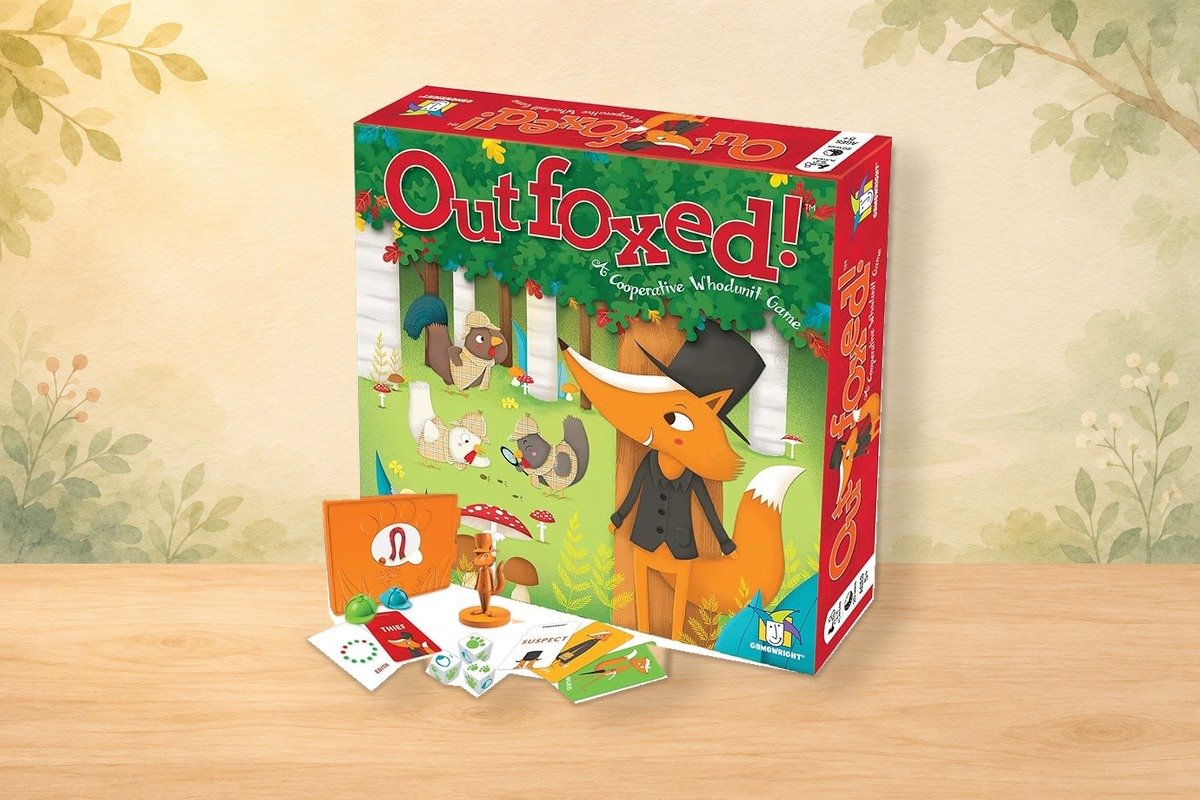
Best for: Kids who like mysteries, clues and solving something together
Publisher age: 5+
Players: 2–4
Typical game time: About 20 minutes
Approx. US price: About $27
Publisher: Gamewright
Outfoxed! is the game I would start with if I knew nothing about the child other than their age.
The premise does a lot of work for me. Somebody stole Mrs. Plumpert’s pie, one of the fox suspects did it, and the players are detectives trying to work out who before the fox escapes. There is a board, suspect cards, clue markers and a plastic evidence scanner that tells the team whether a particular feature belongs to the thief.
That gives the game a purpose a child can understand before they understand every rule.
The part I like most for this list is that the player chooses what kind of information to pursue. On a turn, you decide whether you are trying to search for a clue or reveal more suspects, then roll the dice to see whether you get to carry out that action. The decisions are not buried under a large strategy system. The team has a question and needs to decide what would help answer it.
Where I’d start
Don't begin by explaining the full turn structure. That's boring even for adults but we don't have to luxury to say no. So start with the mystery.
I would show a few suspects, put a clue through the evidence scanner and demonstrate what happens when the clue tells us something about the thief. If we discover that the thief is wearing a hat, we can look at the suspects and start ruling people out.
Now the scanner has a job. The suspect cards have a job. The child knows why we care about clues.
Once that makes sense, you can bring in the choice between searching for clues and revealing suspects, followed by the dice and the fox moving toward the exit.
The point where I’d stop choosing for them
The handoff I want is when I can ask, “What do we need now?” and leave the answer alone.
Maybe I think we need another clue, but the child wants to reveal two more suspects. Fine. Let’s see what that gives us.
There is enough shared information on the table that I can still help if they lose track of what a clue means, but I do not need to turn cooperation into me solving the case while everyone else rolls dice.
That is the risk with Outfoxed!, too. Because the adults can see the deduction structure, it would be easy to take over. If I buy this for a five-year-old, I would want the child making some of the detective decisions rather than serving as the team's dice roller.
Where I’d hesitate
Twenty minutes can be a long game when the child stops caring about the mystery halfway through. The deduction also asks for more attention than something such as Rhino Hero, where the next action is sitting in front of you.
If a child has no interest in clues, guessing or narrowing down possibilities, I would not choose Outfoxed! because it is the most recommended game on a list.
For the child who likes a mystery, though, this is my broadest recommendation here.
2. Dragomino
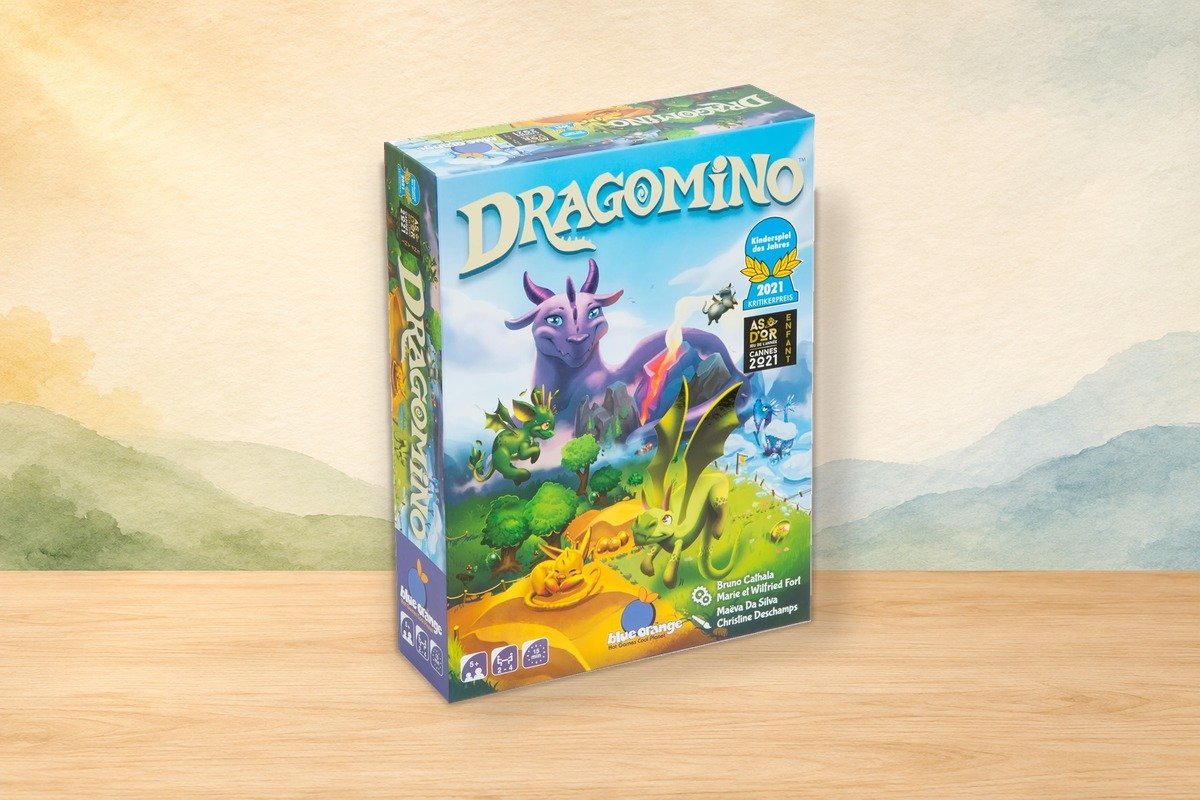
Best for: Kids who like dragons, matching pictures and arranging pieces
Publisher age: 5+
Players: 2–4
Typical game time: About 15 minutes
Approx. US price: About $20
Publisher: Blue Orange Games
Dragomino takes the basic tile-building idea from Kingdomino and strips it down to something I can explain by putting one piece next to another.
Each domino shows two landscape types. On a turn, you choose one of the available dominoes and add it to your growing area. When a landscape on the new tile touches the same type of landscape already in your kingdom, you collect a matching egg token and flip it over.
Sometimes there is a baby dragon underneath. Sometimes there is an eggshell.
That reveal gives the matching rule a reason to matter.
I would not need to tell a child that we are learning tile placement or building a scoring engine. We are joining matching landscapes because that is how we find dragon eggs.
I’d let the first dragon teach the game
I would give the child their starting tile, put the available dominoes where they can see them and ask which one they want.
Then we would work out where it can connect.
If they match two landscapes and get to flip an egg, most of the core game is now visible. Pick a domino, place it, check the new connections and see whether you found a dragon.
There are details I can add later. A newly placed domino can create more than one matching connection. The Mommy Dragon affects who starts the next round. There is no reason all of that needs to arrive before the first egg is flipped.
The decision I care about comes earlier: which tile do you want, and where do you want it?
As the child gets comfortable, I would stop pointing out every matching edge. They can rotate the tile, compare their options and decide whether they care about creating one match, several matches or putting the landscape somewhere that helps a future turn.
Where I’d hesitate
The egg reveal contains luck. A child can make a placement that creates a good match and still flip an eggshell while someone else finds a dragon.
That may be part of the charm for one child and the part that annoys another.
Dragomino also has a gentler competitive feel than Gobblet Gobblers. If the child wants to attack an opponent’s position, block them or feel a direct back-and-forth, this may not scratch that itch.
For a child who likes arranging pieces and the idea of discovering dragons, though, the physical act of building their own little kingdom gives them plenty to own.
3. Gobblet Gobblers
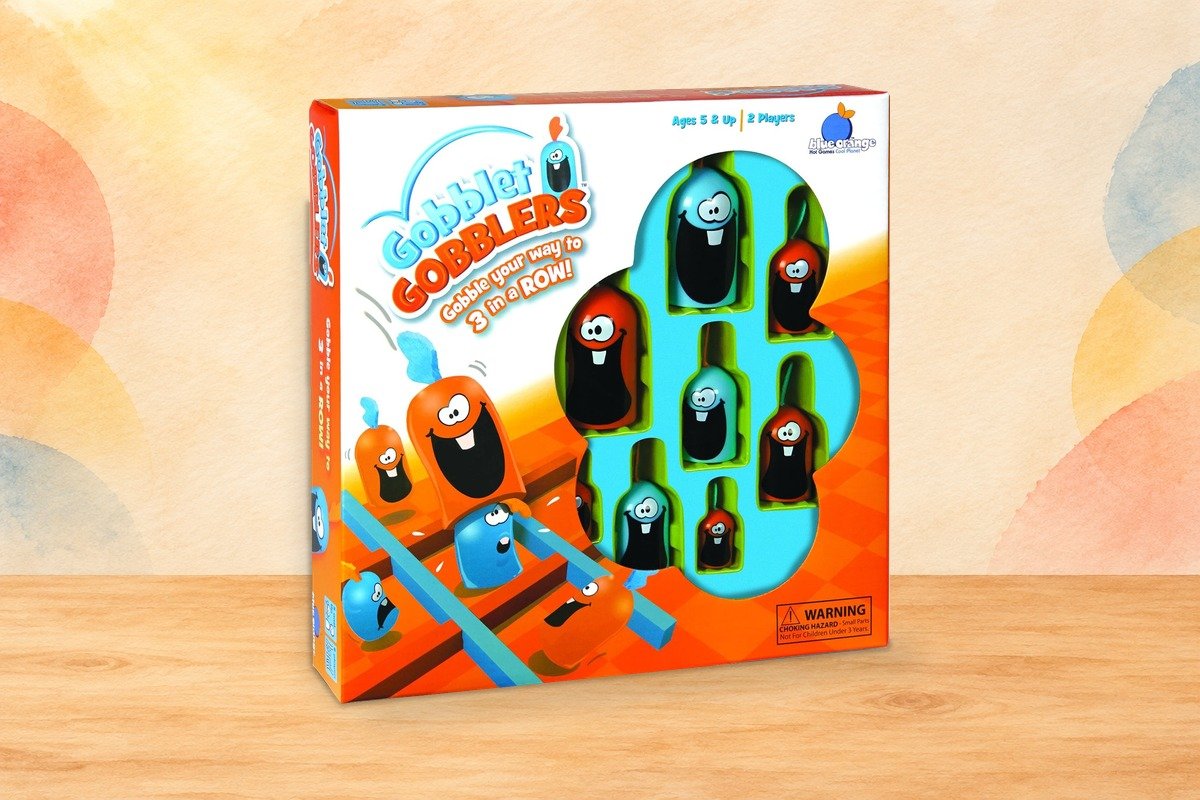
Best for: Kids who enjoy tic-tac-toe, short games and trying to outthink another person
Publisher age: 5+
Players: 2
Typical game time: About 2–5 minutes
Approx. US price: About $22
Publisher: Blue Orange Games
Gobblet Gobblers has the smallest rules explanation on this list and some of the most visible consequences.
At first glance, it is tic-tac-toe. Get three of your pieces in a row.
Then the nesting pieces change everything.
On your turn, you can put a new Gobbler onto an empty space, place a larger Gobbler over a smaller one or move one of your pieces that is already on the board. Because pieces can cover one another, moving something can reveal the piece underneath.
That means a child can make what looks like a good move and discover that they just uncovered an opponent’s winning line.
I like that.
Not because I want them to make mistakes, but because the game gives the mistake back to them in a form that is hard to miss.
I would not coach the board to death
I’d start with the familiar part: three in a row.
Once that makes sense, I would show that a larger Gobbler can cover a smaller one. I would let the moving rule appear once there are pieces on the board and moving one becomes useful.
Then I would try to stop.
Gobblet Gobblers is short enough that I do not need to protect every round from a bad move. If the child puts a piece somewhere that lets me win, we can finish the game and start again a minute later.
That is one reason it appeals to me for this age. The cost of making your own decision is low. You do not spend thirty minutes discovering that the mistake from turn three ruined the entire game.
You get another go.
Where I’d hesitate
This is the most direct competition in the six.
There is nowhere to hide a loss inside a shared team result, and there is no dice roll to blame. One player made the line first.
The covered pieces also create a memory problem that is easy to underestimate. A child may understand the three-in-a-row goal but forget what is sitting underneath the large piece they want to move.
For a child who gets angry when another player blocks them or wins, I would pick one of the cooperative games first. For a child who is starting to enjoy the idea of outsmarting me, Gobblet Gobblers is the game here I would expect to grow fastest with them.
4. Monza
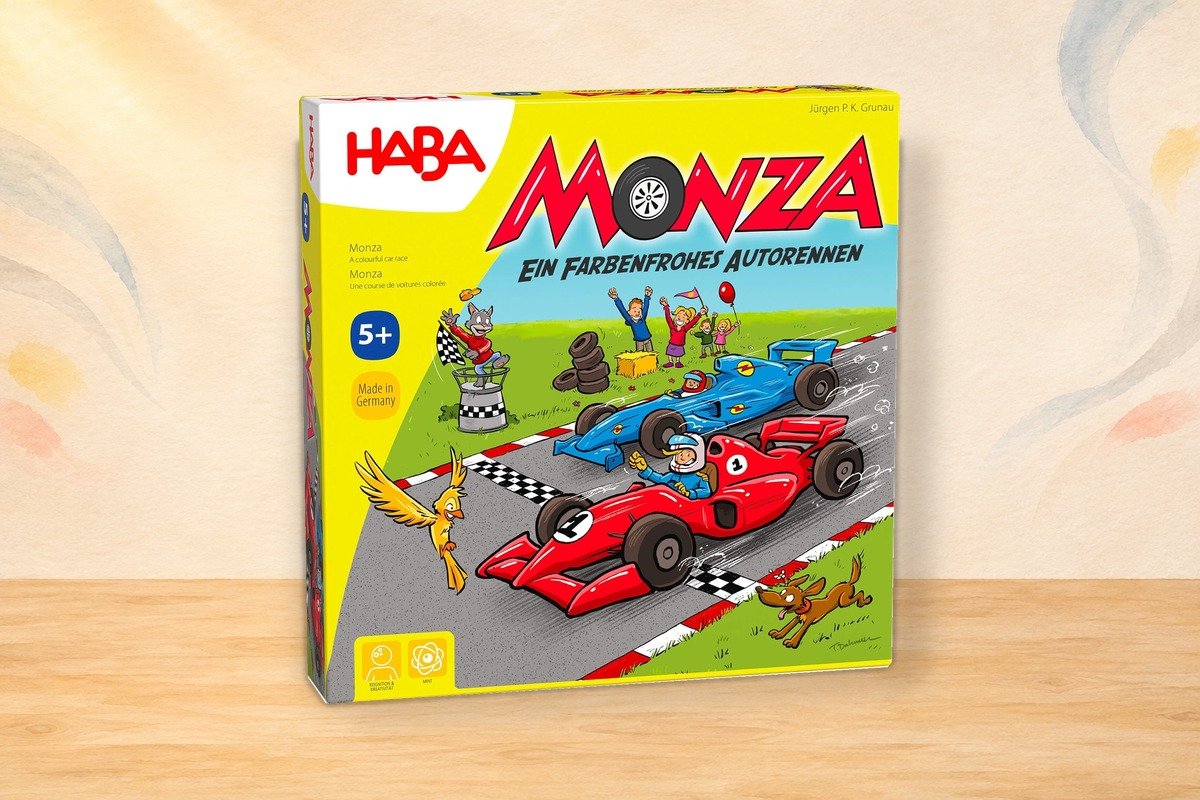
Best for: Kids who like cars, racing, dice and finding routes
Publisher age: 5+
Players: 2–6
Typical game time: About 15 minutes
Approx. US price: $24.99
Publisher: HABA
Monza looks like a dice game, but the part that earns it a place here happens after the dice hit the table.
You roll six colored dice. The racetrack is made from colored spaces, and you try to use as many of the colors you rolled as you can to move your car forward.
The order matters.
A blue die followed by yellow may take you one way. Yellow followed by green may open another route. Lane changes, blocked spaces and other cars create more possibilities as the race develops.
Luck gives the child the ingredients. They still have to decide what to do with them.
That is a useful kind of decision because I can make it visible. I can put the dice beside the board and trace possible routes without needing to explain an abstract strategy.
Where I’d start
I would roll the six dice, pick one color that matches a space in front of the car and put that die beside the space.
Then I’d look for another color that continues from there.
For the first turn, I would care less about finding the longest route than showing how one die can lead to the next. Once the child understands that the colors can be chained together, I can stop building the route for them.
This is also where I would need to watch myself.
If I can see a five-space route and the child has found a three-space route, I do not need to turn every turn into a correction. The interesting question is whether they understand the relationship between their dice and the track.
If they do, the route can be theirs.
Later I can introduce the details about changing lanes, blocked spaces, passing other cars and what happens when a move ends on an occupied space.
Where I’d hesitate
Monza still contains a lot of luck. Some rolls give you more useful colors than others, and that can matter in a race.
It also becomes an adult puzzle fast if the parent cannot resist finding the maximum possible movement from every roll.
That would defeat the reason I put it on this list.
I would choose Monza for the child who looks at six colored dice and a racetrack and wants to work something out. If they want the car to move because the die told it exactly how far to go, there are easier racing games.
5. Race to the Treasure
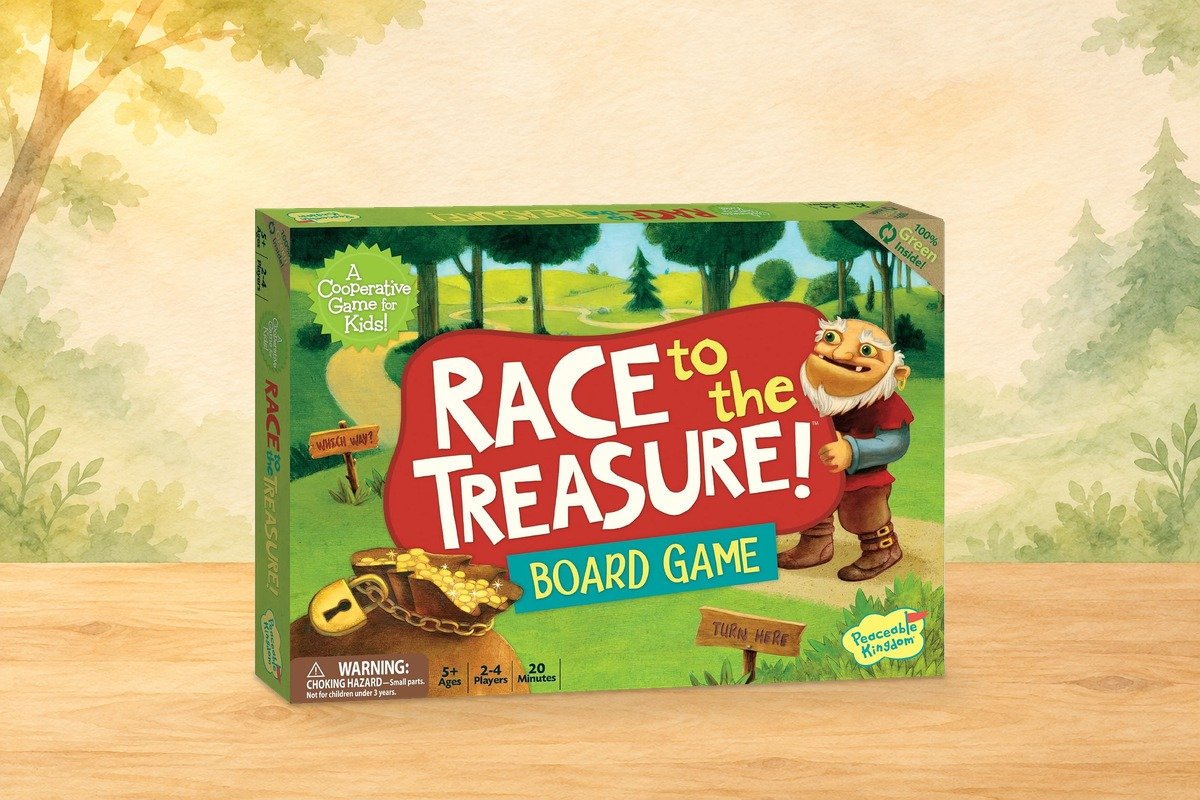
Best for: Kids who like teamwork, maps and building a route together
Publisher age: 5+
Players: 2–4
Typical game time: About 20 minutes
Approx. US price: $19.99
Publisher: Peaceable Kingdom
Race to the Treasure turns most of the board into one shared decision.
The team is trying to build a continuous path from the start to the treasure before the Ogre reaches it. Keys are placed around the board, and you need to collect three of them on the way. Each turn reveals either a path card you can add to the map or an Ogre card that moves the threat closer to the end.
The path cards are where the game becomes interesting.
They can be placed in different directions, and the team may have several possible routes growing at the same time. You need to reach enough keys without wasting so many cards that the Ogre gets there first.
There is also an Ogre Snack that can remove one Ogre card once you collect it, which creates another shared decision about when to use it.
Let them own part of the route
I would start by pointing out the start, the treasure and the keys.
Then I would draw the first path card and ask where it should go.
I do not need to explain the whole strategy before the first tile hits the board. The child can see that roads connect to roads. Once a few pieces are down, the problem becomes concrete: which key are we heading toward, and where does this new card help?
Because the game is cooperative, I can talk through a difficult position without playing against the child. That makes it a comfortable place to hand over more responsibility.
But cooperation creates its own problem.
Adults can dominate cooperative games without noticing. If I rotate every card, point to the best square and explain why we need the northern key instead of the western one, the child may be participating while I make every meaningful choice.
I would rather let them suggest a route and see where it takes us.
Where I’d hesitate
The shared path means nobody has their own pawn or personal area. For some children, building one map together will be the appeal. Others want something that is visibly theirs.
The game also asks the players to think about a board-wide plan. If the child wants each turn to have an immediate result, Rhino Hero or Gobblet Gobblers gets there faster.
I like Race to the Treasure as the cooperative counterpoint to Outfoxed!. One is about information and deduction. The other is about space and route planning.
6. Rhino Hero
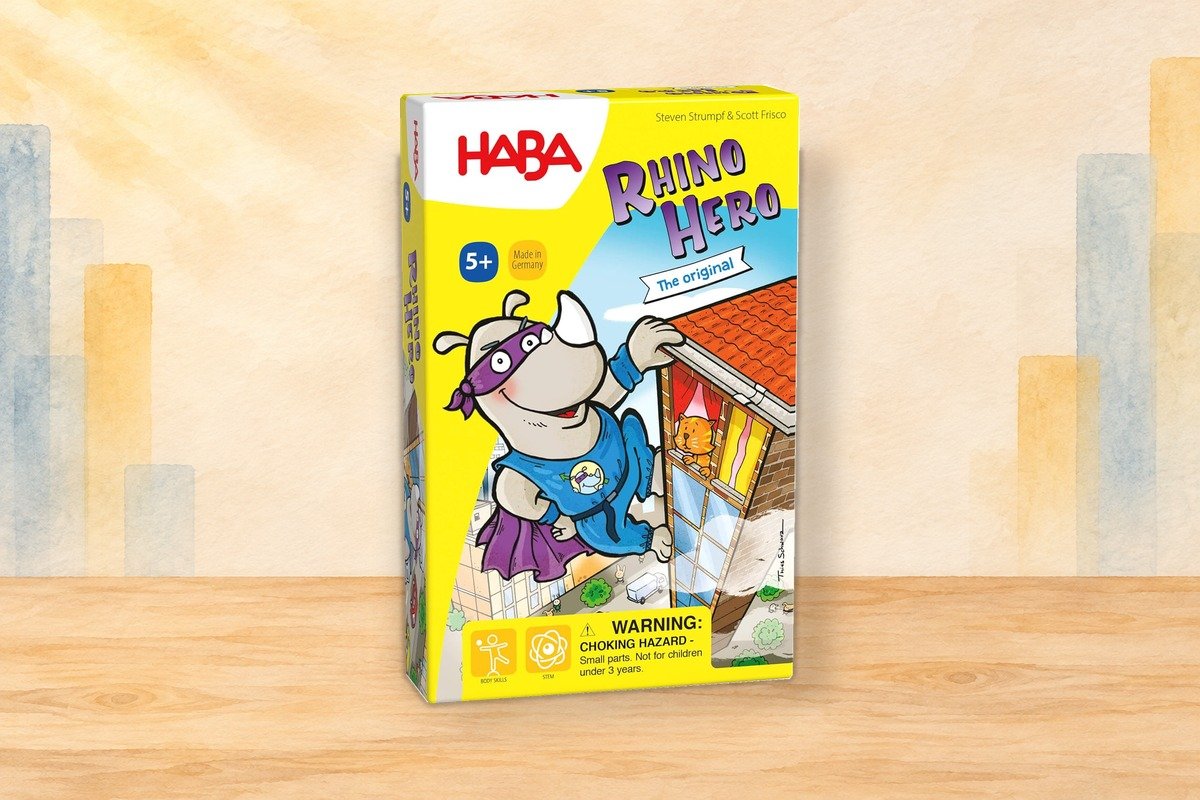
Best for: Kids who like building, balancing and watching structures wobble
Publisher age: 5+
Players: 2–5
Typical game time: About 5–15 minutes
Approx. US price: $14.99
Publisher: HABA
Rhino Hero is the easiest game here to make interesting before the rules matter.
You are building a skyscraper from folded wall cards and roof cards.
That is enough to begin.
I can put down the starting card, add the walls where the outlines show they belong and place a roof on top. The child can add the next floor. If the tower falls while we are learning what goes where, we already know what happens next: build it again.
The full game adds a hand of roof cards and action symbols. Depending on the card, the direction of play may change, somebody may have to draw another card, a player may get another turn or Rhino Hero himself may need to move higher up the tower.
Those rules give the card choice more consequence once the physical game is familiar.
I’d start with the building, not the symbols
The tower is the hook, so I would let it do its job.
I would show how the wall outlines on the roof tell us where the next walls need to stand, then let the child place them. Once the basic construction rhythm feels normal, the action symbols can start changing what happens between turns.
The hand of roof cards then gives the child a choice: which one do I want to play, and what will that make the next player do?
There is also a handoff that has nothing to do with strategy.
At some point I need to stop steadying the building.
If I keep one hand beside the tower and fix every wall that leans, I have removed the tension that makes Rhino Hero work. The structure needs to be allowed to wobble.
And sometimes it needs to fall.
Where I’d hesitate
For a child who finds a collapsed tower upsetting, the central joke of the game may not feel funny.
Rhino Hero also asks for more hand control than anything else in the shortlist. The decision can be right and the tower can still fall because somebody bumped the table or placed a wall at an angle.
That is part of why I like it, but it makes this a different kind of board game from Outfoxed! or Monza.
If the child likes building and does not mind starting again, this is the cheapest and fastest game on my shortlist to get onto the table.
So, Which Board Game for a 5-Year-Old Would I Start With?
If I knew nothing else about the child, I would start with Outfoxed!
The mystery gives the game a reason to exist beyond moving pieces around a board, and the cooperative structure lets an adult help without needing to lose on purpose. More importantly for this list, the child can begin owning part of the investigation. They can decide whether the detectives need another clue or more suspects, look at what the evidence tells them and help narrow the field.
That gives me somewhere to step back.
I would choose something else as soon as I knew more about the child.
For a kid who wants dragons and enjoys arranging pieces, I would take Dragomino. If they like head-to-head games and want another round the moment the first one ends, Gobblet Gobblers is the strongest fit. A child who loves cars gets a more interesting decision from Monza than from a race where the die tells them exactly how far to move.
Race to the Treasure is my pick for a child who likes solving something together but is more interested in building a route than solving a mystery. Rhino Hero is where I would go if sitting over a board is the least interesting part of board games for them.
That is why I would not call Outfoxed! the best board game for every five-year-old.
It is the one I would buy when I have no other information.
Once I know what the child wants to do, I would let that answer choose the game.
How I Chose These Board Games for 5-Year-Olds
As with all my board game research, I started with the publisher age. Parents play plenty of games before the minimum age printed on the box, and some five-year-olds will enjoy games whose publisher recommendation starts at six or later. That does not make those games useful starting recommendations for every parent searching for a board game suitable from age five.
So to keep it simple, the six main picks here all have publisher recommendations that start at age five.
After that, I moved to the key questions. What that means is that I cared more about what the child gets to do than what skill somebody claims the game develops. A box can promise strategy, problem solving or cooperation, but those labels do not tell me what the first turn looks like.
Here are quick examples from each game. A sneak peek if you will. In Outfoxed!, the team needs to decide what information to uncover. In Dragomino, the child chooses a tile and where to connect it. Gobblet Gobblers gives them a direct tactical move. Monza gives them several colored dice and asks them to find a route. Race to the Treasure turns the board into a shared path problem. Rhino Hero makes the decision physical: what card do I play, and can I add another floor without bringing the building down?
So the result is by no means a ranking from best to worst. It is six different kinds of play, with six different opportunities for the adult to give some control away.
How I Researched This Guide
I used publisher information and game rules for the factual parts of this guide: minimum recommended ages, player counts, playing times, components and how the games work.
For the shortlist itself, I looked beyond whether a game carried a 5+ label. I wanted to know what a child gets to decide once the basic loop makes sense, how much of that decision an adult can demonstrate instead of explain, and whether the game still has somewhere to go once the first novelty wears off.
I also looked at specialist board-game recommendations and parent discussions to see which games keep coming up around this age and what families find easy or awkward in practice. I use those experiences as clues about what deserves a closer look, not as proof that every five-year-old will respond the same way.
The final six are my judgment based on that research and on how I would introduce each game.
Browse Board Games by Age
Looking for games for a different age? Browse the other Little Moment Play board game guides:
Need Something to Do Right Now?
If you’d rather browse a few ideas first, see my activities for 5-year-olds.
If you’re unsure what fits right now, use the Activity Finder for one suggestion based on age, time, setup and mess.