

By Antonio
My son is two now, and recently my wife and I started focusing more on giving him opportunities to play without one of us directing everything. The idea seemed simple enough: get him interested in something, let him take over, and use that time to make lunch, tidy up, or just rest my legs on the couch, do nothing. Yeah, right…
So I gave it a couple of tries to make my 2-year-old an independent machine. I failed. Which forced me down a research rabbit hole. A couple of days later, I’m here to provide my great summary.
Besides articles, I also went through the CDC’s guidance on child-led play, research on toddler attention, parental scaffolding, choice and free play, and guidance from organizations including ZERO TO THREE, WHO, the American Academy of Pediatrics and the U.S. Consumer Product Safety Commission. The good stuff.
But even with all my internet research powers, I’m still a parent, not a developmental specialist, and this isn’t a scientific paper. My goal was to make my kid independent so maybe I can have 15 minutes of solo time and play video games. Like a true grownup.
I did learn some useful things, so I’m sharing them here. The main thing I learned is that independent play isn’t something you switch on. It is a gradual handoff. If you don’t have the time to read, I created this nice widget that you can use. Or you can read more about the tactic below.
 Gradual Handoff Help
Offer two familiar options, then start using the chosen materials yourself. With cars, push one alongside your toddler; with blocks, begin a simple stack.
“Blocks or cars? I’m going to start here.”
When your toddler reaches in or begins their own version, leave room for them to lead. You can become less involved without leaving.
Try different materials or leave it for later. You don’t need to persuade them to enjoy this particular activity.
Join them for a little longer. Once they’re involved, try doing less: hold the container while they choose what goes in, or watch while they decide what happens next.
“I’m here. You choose what happens next.”
Notice whether they carry any part of the play without another prompt. Remain nearby and available.
Some moments call for more connection. Playing together is still worthwhile; independence doesn’t have to happen this time.
If your toddler is absorbed and the setup is safe, pause your questions, instructions and new ideas. Let the activity continue without adding a new task.
If they check in: “I’m right here.” Otherwise, you may not need to say anything.
Stay nearby. Watch for whether they keep the play moving themselves, rather than measuring how many minutes it lasts.
If they ask you back, respond. You can briefly rejoin and reduce your involvement again when it feels right.
Offer the smallest useful bit of help. Hold the puzzle board steady or rotate a difficult piece, then let your toddler try again.
“I’ll hold this. You try.”
When they get moving again, stop adding help unless they need it. They don’t have to finish the activity for this to be useful.
If frustration keeps building, return to playing together, choose something simpler, or take a break.
Notice what still catches their attention. You could offer different materials, reduce competing toys, or try a different place. Ask whether the activity interests them before asking them to stay with it.
“Want to try something else, or shall we put this away?”
If something new draws them in, start together again and give them room to take over.
Put it away without making it a battle. Losing interest today doesn’t mean your toddler has failed to learn independent play.
Select a situation to see one small thing to try.
Also, here are core 3 things I feel are the most important.
How to Encourage Independent Play: The Gradual Handoff
I did not find a study testing one magical step-by-step program for teaching toddlers to play independently. Figures.
So what follows is my super dad-science synthesis of research on child-led play, choice, sustained attention, parental scaffolding and the play environment.
Start together → help them engage → let them lead → step back → help only when needed → repeat
How long does it take to learn independent play?
This was one of the first things I wanted to know. Was I impatient? Probably. I really wanted some solo time.
Unfortunately, I didn’t find a research-backed training timeline saying a toddler should learn independent play in two weeks, one month or any other fixed period. To be honest, this sort of reminded me back when I started bouldering and I wondered when will I be ready for bigger challenges.
Anyhow. The CDC recommends practicing child-led play consistently and gradually becoming better at following rather than directing the child. Its suggested 5–15 minutes refers to parent-and-child child-led play, not to an amount of time a toddler should be playing alone. Basically, the kid is Batman and you’re the sidekick who needs to ensure Batman has fun and doesn’t hurt themselves.
Research on parental scaffolding and later executive function follows a similar principle: adults provide support that matches what a child can manage and reduce that support as the child becomes more capable.
So I wouldn’t put a deadline on it. For our family, a more useful way of thinking about progress is not “Can he play alone for 20 minutes yet?” but “Does he need a little less help carrying the activity than he used to?” If your toddler can play for two or three minutes without needing you to provide the next idea, progress may first mean that those few minutes happen more often.
1. Start together
If your child wants you to play, beginning with “Go play by yourself” may skip the part they still need help with: becoming interested enough in something to keep going once you stop participating.
The CDC’s child-led play recommendations offer a useful starting point.
The CDC recommends letting the child take the lead, following what they are doing, and limiting unnecessary questions and directions. At this point, you are still playing together, and that is part of the process rather than a failure to achieve independence.
If your toddler has cars, push one alongside them. If they have blocks, start building. If they are moving animals between containers, join them for a moment. The goal is not to make yourself unnecessary immediately. It is to help the child become engaged enough that there is something for them to continue after your role becomes smaller.
How to get them interested: Start using the materials in a simple way without explaining everything they should do.
Then let them take over: When they begin creating their own version of the activity, stop supplying new ideas and see where they take it.
Not interested? Try different materials rather than pushing harder.
An activity that surprised me how fast my kid caught up was playing pretend cafe. That game where toys are guests and you bring them food and drinks. By food and drinks I mean any other toy that’s not the guest right now.
He caught up straight away and at one point I just backed out and he kept playing. But after 5 minutes or so he came running to my table with the plate demanding I play as well. That was it. I could see the independent battery was at 0%.
2. Make the choice smaller
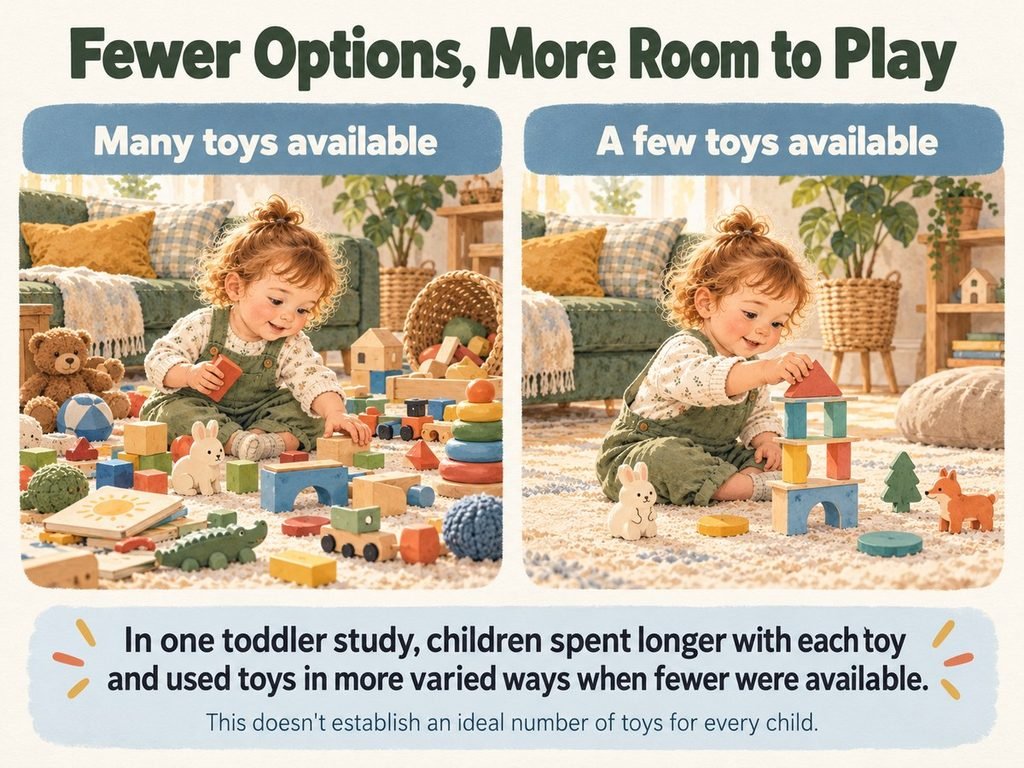
More toys do not necessarily create more play. In a 2018 study of how the number of available toys affected toddler play, 36 toddlers played in sessions containing either four or sixteen toys. When four toys were available, the children spent longer with individual toys and used them in a greater variety of ways.
The study did not test toy rotation, and it does not mean four is a magic number. What it gives us is a simpler idea to test at home: if a toddler is surrounded by many competing options, reducing what is in front of them may make it easier to stay with one thing.
Instead of emptying a toy box onto the floor, I would try putting out a few things the child already knows how to use and see what happens.
3. Give them some control
Another study I found points that choice seems to matter too. A study of sustained attention in two-year-olds found longer sustained attention when teachers offered a choice between two highly preferred toys than in the other conditions tested. A newer study of sustained attention and choice in three-year-olds also found longer engagement when children had more control over the activity than when one was simply presented to them.
For a toddler, this does not need to become a big open-ended question like “What would you like to do?” Giving two manageable choices may be enough: “Blocks or cars?”
That leaves the adult in charge of creating a workable environment while giving the child a real decision inside it. It is a small distinction, but it changes the activity from something being assigned to something the child has helped choose.
4. Stop directing when the play is working
This is the part I think we as parents overlook. Once a toddler becomes interested, we start contributing. We ask what they are building, suggest where a piece should go, point out colors, propose a new idea or turn the activity into a small lesson.
Sometimes children want that interaction, and there is nothing wrong with it. But when the goal is to let them carry more of the play, we also need to recognize when our input is no longer helping.
The CDC advises parents to limit unnecessary questions and directions during child-led play because those interactions can shift control back toward the adult. Research with 57 toddlers aged 15–24 months adds some useful nuance. In a study of mother-toddler interaction and symbolic play, children showed more complex symbolic play when playing with their mothers than when playing alone, but maternal intrusiveness and questioning were negatively related to symbolic play.
The lesson isn’t that parents make play worse. It is that being involved and being in charge are not the same thing. If your toddler is absorbed, there may be nothing you need to add.
5. Stay nearby without staying in charge
Independent play does not require leaving the room. ZERO TO THREE’s guidance on independent play describes a child playing by themselves while the caregiver remains nearby, which is an important distinction when talking about toddlers.
You might make lunch, fold laundry, drink a coffee, or sit nearby while your child continues the activity. The child is playing independently because they are carrying the play, not because you have disappeared.
For me, that makes the goal much more realistic. Independent play is not about creating distance between parent and child. It is about becoming less necessary to the activity while remaining available when you are needed.
6. Help only enough to get them moving again
Independent play also doesn’t mean refusing to help when your child gets stuck. Research on scaffolding looks at how adults provide enough support for a child to manage a task and adjust that support as the child’s abilities change.
One longitudinal study of parental scaffolding and executive function followed 82 children at ages two, three and four. Parental scaffolding at age three predicted later executive-function performance at age four, although this was not a study of independent play itself.
At home, the useful principle is simpler. If a puzzle piece isn’t fitting, you do not have to choose between finishing the puzzle for your toddler and refusing to help. You might rotate the piece or hold the board steady, then let them try again. The aim is to provide enough help to get past the roadblock and then return the activity to the child.
7. Repeat instead of expecting steady progress
A toddler may play without much help one morning and want you beside them for every activity that afternoon. That doesn’t mean the process has stopped working.
Attention itself changes with context. A longitudinal study of sustained attention across toddlerhood followed 314 toddlers at 30, 36 and 42 months and found some stability in attention over time, but different measures of attention were only weakly related in some circumstances. Language and sleep were also associated with attention development.
That is another reason I wouldn’t treat independent play as one fixed ability that can be measured with a stopwatch. The pattern I want to make familiar is simpler: we can start together, you can take over, and I’m still here when you need help.
What Does “Independent Play” Mean?
Now that we have practical steps out of the way, I’d like to clear up some terminology.
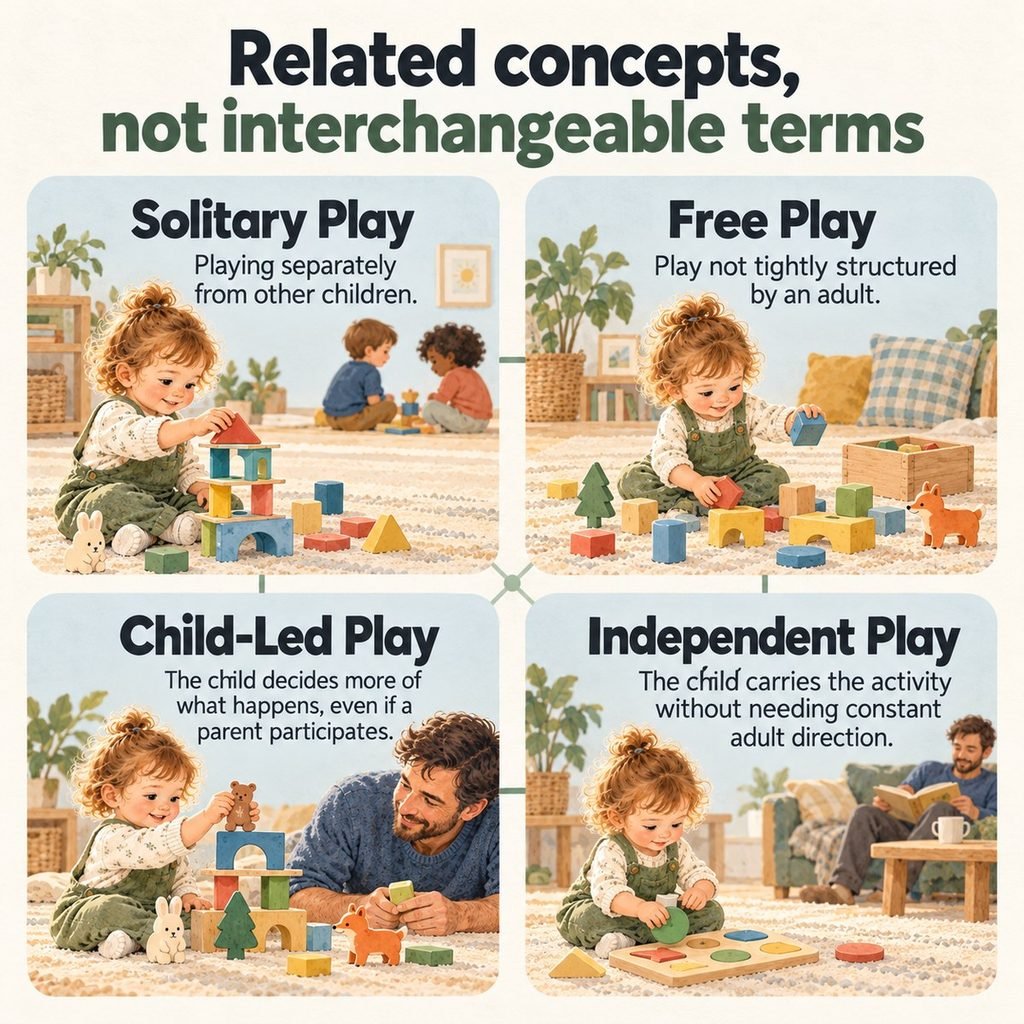
The terminology gets confusing because several types of play are grouped together online even though they are not interchangeable.
Solitary play describes a child playing separately from other children. It comes from research on children’s social participation and does not necessarily tell us whether an adult is helping direct the activity. Free or unstructured play means the activity isn’t tightly organized by an adult, but it can happen alone, with a parent, or with other children.
Child-led play means that the child controls more of what happens even if the parent still participates. That is the type of play covered by the CDC guidance used earlier in this article.
For this article, I’m using independent play to mean a child carrying an activity without needing an adult to continually entertain, direct or solve it for them. The adult may still be nearby, which is why independent play should not be confused with unsupervised play.
Does Independent Play Have Developmental Benefits?
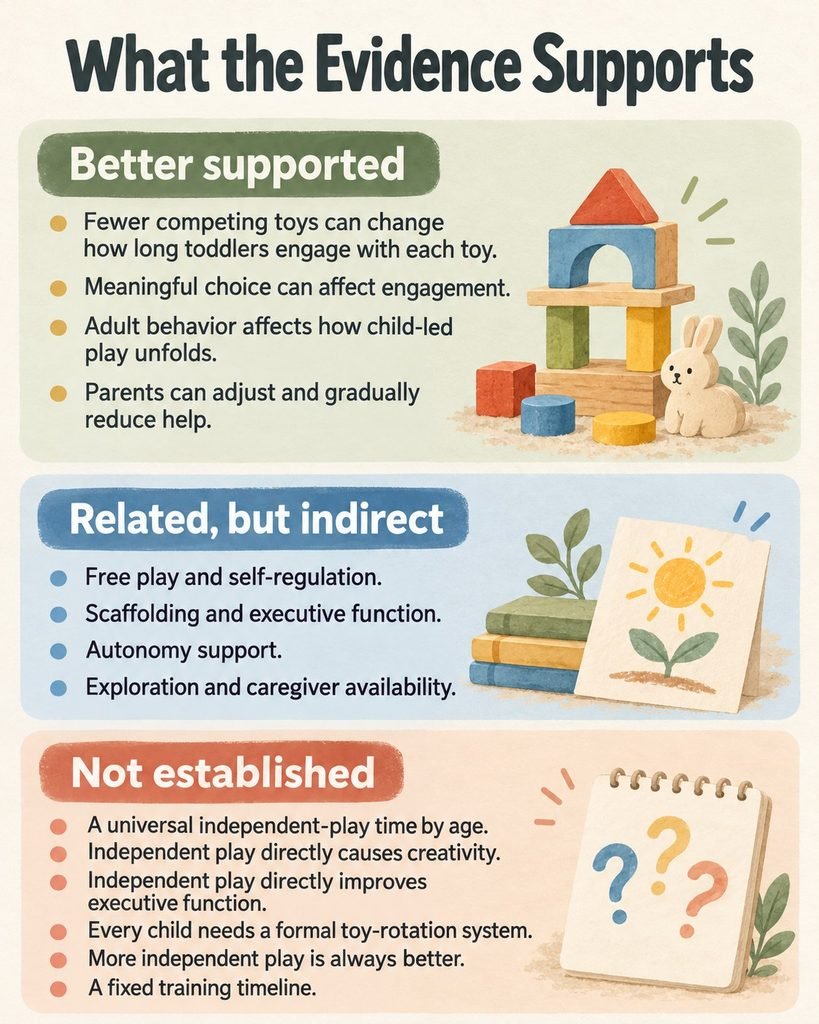
One of the bigger surprises from my research was how difficult it is to support some of the claims commonly made about independent play. There is useful research around the topic, but much of it studies free play, parent-child interaction, sustained attention, choice or autonomy rather than independent play itself.
That does not make the research irrelevant. It just means we need to be careful about what conclusions we draw from it.
Self-regulation: promising, but indirect
A large Australian longitudinal study followed 2,213 children and found that more time spent in quiet, unstructured free play at ages two to three and four to five modestly predicted better self-regulation later. The researchers controlled for earlier self-regulation and several other factors. You can read the original study, Free play predicts self-regulation years later.
The important limitation is that the play was not necessarily independent, and the study was observational. It supports a relationship between free play and later self-regulation, but it does not show that teaching a toddler to play alone will improve self-regulation.
Attention: the environment matters
The evidence around attention is more useful for day-to-day parenting. The toy-number study showed that changing the number of available toys changed how toddlers played, while studies with two- and three-year-olds found differences in engagement depending on the choices children were given.
That tells us something important about how we interpret a toddler who “won’t focus.” Attention is not only about the child. The activity, the environment and the way the choice is presented can all influence how long they stay with something.
Executive function: don’t make the causal leap
Research links parental scaffolding and autonomy-supportive behavior with aspects of executive-function development, but those studies are not trials of independent play. For that reason, I would not say that independent play itself has been shown to build executive function.
A more accurate interpretation is that choice, autonomy and appropriately timed adult help are part of the developmental picture around executive function. Those same principles may also be useful when trying to help a toddler carry more of their own play, but that connection is a synthesis rather than a demonstrated causal effect.
Creativity and problem-solving
The same caution applies to creativity and problem-solving. It is easy to see why child-directed play could give children opportunities to experiment, make decisions and come up with their own solutions, but that is not the same as proving that independent play makes children more creative or better problem-solvers.
I would rather leave those benefits in the “possible” category than turn them into promises the research cannot support.
At What Age Should Toddlers Play Independently, and for How Long?
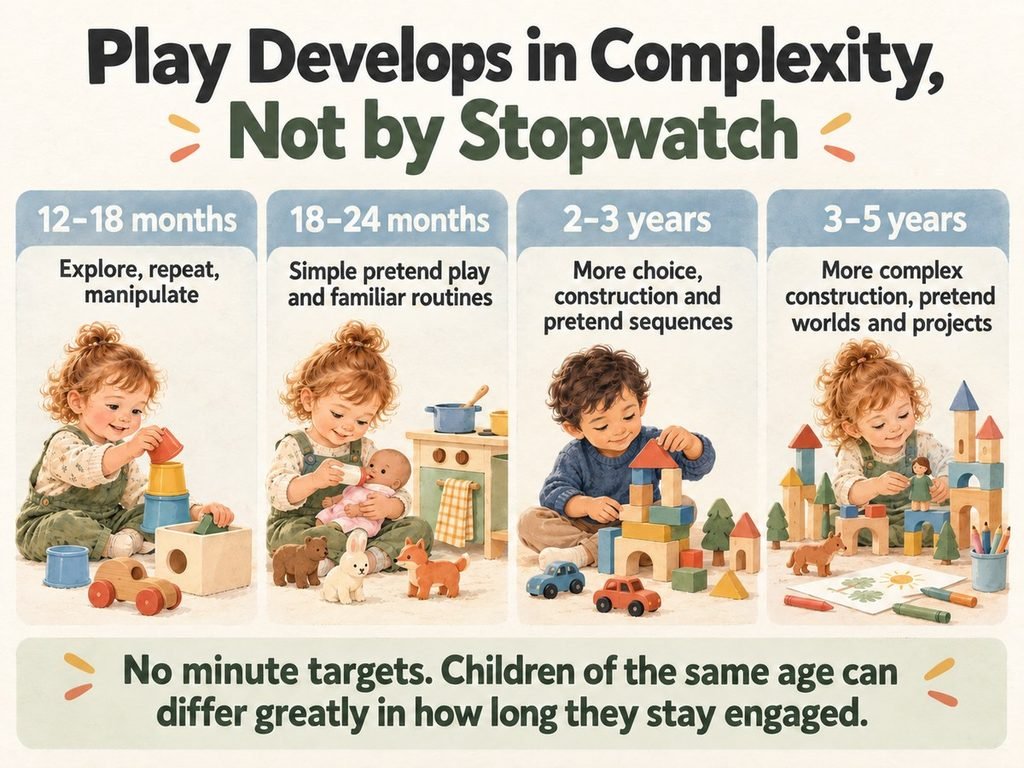
I would be cautious with age charts telling parents that a one-year-old should play independently for a certain number of minutes and a two-year-old for another amount. I couldn’t find validated developmental standards for that.
I think that feeling where you start wondering if everything is ok with my kid starts to creep in. Don’t overthink it. How long a toddler plays independently, by itself, isn’t a useful way to judge whether their development is on track.
ZERO TO THREE publishes rough attention estimates and suggests beginning independent play in short periods, but these are practical parenting guidelines rather than validated independent-play milestones. The research itself shows wide variation depending on the child, the activity and the situation.
12–18 months
At this age, much of play involves exploring objects through repetition: pushing, dropping, stacking, opening, closing and moving things between places. Independent play may simply mean the child carrying that exploration for a short stretch while you remain nearby.
That may not look impressive from an adult perspective, but repeatedly putting an object into a container and taking it out again can be the whole activity.
18–24 months
Play becomes more varied, and early pretend play begins to expand. The research on parent-toddler symbolic play suggests that adults can enrich play while still leaving room for the child to determine what happens next.
This is where the distinction between helping and directing becomes useful. The parent can participate without becoming the engine that keeps the activity moving.
2–3 years
This is the stage I’m dealing with now. Research on two-year-olds shows that activity choice can affect how long children remain engaged, while attention itself is still developing and varies across situations.
That makes progress within your own child more meaningful than comparing them with a universal time target. If they can carry an activity a little longer, need fewer prompts, or return to something without you restarting it, those changes may tell you more than whether they have reached a particular number of minutes.
3–5 years
As children get older, their construction, pretend and creative play can become more complex and sustained, but age alone still doesn’t tell us how long an individual child should play independently.
In the study of 93 three-year-olds mentioned earlier, engagement varied widely even among children in the same experimental conditions. Children of the same age can therefore look very different without one necessarily being “better” at independent play.
What Helps Toddlers Stay Engaged?
After going through the research and doing dad-science, this is my practical summary.
| Strategy | What the research tells us | What I would try at home |
|---|---|---|
| Fewer toys available | One toddler experiment found longer play with individual toys when fewer were available | Put out a few options instead of everything |
| Meaningful choice | Studies with two- and three-year-olds found that choice can affect engagement | Offer two good options |
| Start together | Child-led guidance and parent-child play research support responsive involvement | Help the activity get moving first |
| Step back when it works | CDC guidance recommends limiting unnecessary directions and questions | Don’t interrupt absorbed play just to add something |
| Help without taking over | Scaffolding research supports adjusting assistance to the child’s needs | Give the smallest bit of help that lets them continue |
| Stay nearby | Professional guidance treats independent play as compatible with caregiver presence | Do your own task close enough to remain available |
| Toy rotation | Fewer toys may help, but rotation itself wasn’t tested in the toddler toy study | Try it if your play area feels overloaded |
| Routine | Predictability is recommended in professional guidance | Give independent play repeated opportunities without making it a chore |
None of these is a guaranteed technique, and I wouldn’t try to introduce all of them at once. The simplest starting point may be to choose one familiar activity, reduce the number of competing toys, begin with your toddler, and see whether you can become less involved once they are engaged.
Why Some Toddlers Need More Help
If your toddler doesn’t happily play on their own, that doesn’t mean something is wrong or that you have failed to teach the skill. Sometimes the explanation is much simpler.
The activity is too difficult
If your child needs you every few seconds, they cannot carry much of the play themselves. That may mean the activity requires too much help rather than that the child needs more independent-play practice.
A better activity is one where they understand enough to keep doing something meaningful after your role becomes smaller.
They aren’t interested
The studies on choice and sustained attention reinforce something parents already see every day: the activity itself matters. A carefully prepared activity can still lose to a cardboard box.
Instead of interpreting that as refusal to play independently, it may be more useful to ask whether the child was interested in the activity in the first place.
They want more connection that day
Responsive caregiver interaction remains important during the first years of life. The WHO guideline on early childhood development recommends responsive caregiving and opportunities for early learning with caregivers during the first three years.
Independent play shouldn’t be built by treating a child’s need for connection as a problem. Some days, starting together for longer may be what makes stepping back possible.
Children differ
Temperament, language, sleep, sensory needs, development and familiarity with an activity can all influence how a toddler engages. Two children can therefore respond very differently to the same setup.
That is another reason I don’t find independent-play timers very helpful. They make something highly dependent on context look more standardized than the research suggests it is.
Independent Play Doesn't Replace Playing Together
I don’t want my son to learn independent play because I think playing with parents is bad or unnecessary. I want him to have another way to play.
Parent-child interaction still matters. WHO recommends responsive caregiving in the first three years, and research on toddler symbolic play shows that playing with a parent can support more complex forms of play. Independent play offers something different: time in which the child gets to make choices, follow an idea and continue without an adult supplying every next step.
Those two kinds of play don’t need to compete. We can build something together, and later he can use the same materials without me directing what happens.
What We Know, What We Think, and What We Still Don't Know
What we know
The environment and the way an activity is presented can change toddler engagement. Fewer competing toys can support longer play with individual toys, and meaningful choice can influence sustained attention. Adult involvement also matters, and parents can support play without controlling every part of it.
What we think
Research on child-led play, scaffolding, choice and attention gives us good reasons to use a gradual handoff: begin with enough support to get the child engaged, then reduce that support once they start carrying the activity themselves.
That is an evidence-informed synthesis, not a tested independent-play program.
What we still don’t know
We don’t have a validated independent-play duration by age or a fixed timeline for learning it. We also can’t say that increasing independent-play time directly causes stronger creativity, executive function, confidence or resilience.
There isn’t one proven toy-rotation schedule or one ideal balance of independent and shared play that applies to every child. Those gaps matter because they stop practical advice from turning into another list of rules parents feel pressured to meet.
Independent Play Ideas by Age
These aren’t activities proven to teach independent play. They are simply examples of activities that can give young children enough room to continue without constant adult direction.
12–18 months
Large stacking cups, board books, soft blocks, push toys, or large objects that can be moved in and out of containers can work well because the child can repeat the same action without needing a complicated outcome.
If you need more options for this stage, browse our activities for 1-year-olds.
18–24 months
Chunky blocks, nesting containers, large figurines, familiar puzzles and simple pretend objects give the child several ways to continue without needing you to invent a rule or sequence.
At this age, I would still expect plenty of checking in and parent involvement. The goal is not to make the child play alone, but to give them moments where they can carry more of what is happening.
2–3 years
Blocks, vehicles, animal figures, drawing materials, pretend kitchens, dolls and simple sorting activities can all work. The important question isn’t which category an activity belongs to, but whether your child understands enough about it to keep doing something once you stop directing it.
Our activities for 2-year-olds and quiet activities for toddlers are useful places to look when you want something suited to this stage.
3–5 years
Construction, drawing, pretend worlds, dress-up, play dough, simple crafts, puzzles and small-world play allow children to create longer sequences as their skills grow.
If you’re not sure what to offer, the Little Moment Play Activity Finder can narrow activities based on age and practical limits such as setup and mess. It is an activity-discovery tool, not a developmental assessment.
Independent Play Is Not Unsupervised Play
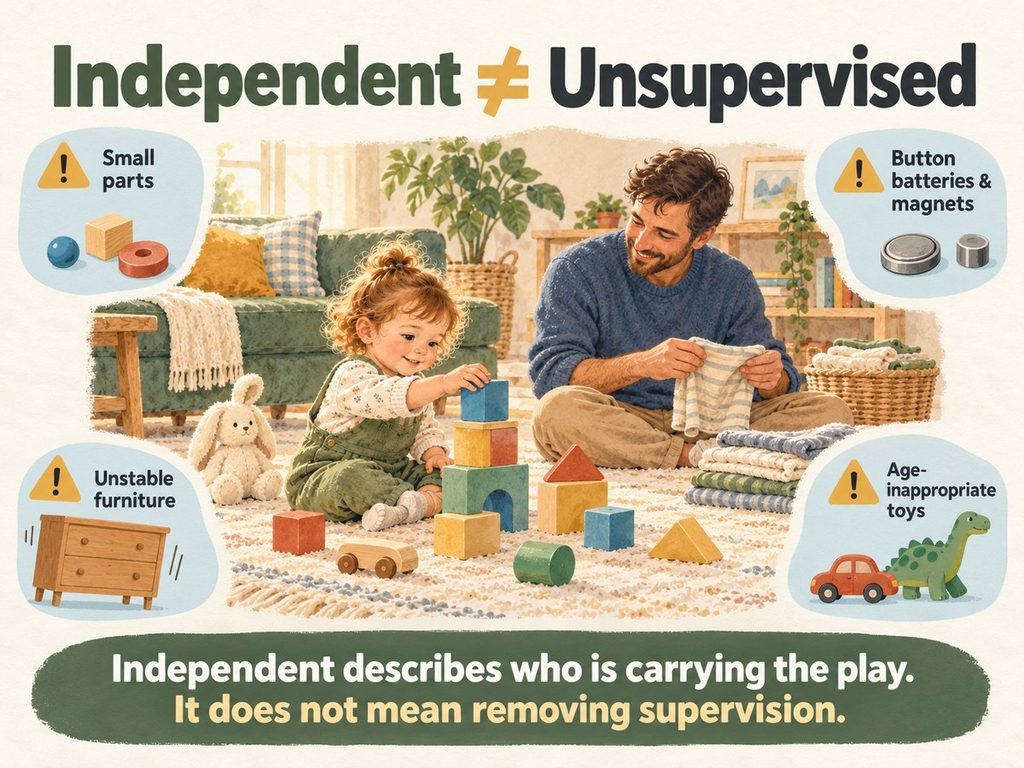
For toddlers, “independent” describes who is carrying the activity. It does not mean the child no longer needs appropriate supervision.
The U.S. Consumer Product Safety Commission’s toy-safety guidance recommends following age guidance and keeping small balls and toys containing small parts away from children under three.
The physical setup matters too. A child has a better chance of carrying an activity without repeated adult help when safe materials are within reach, furniture is secure, and the activity does not require climbing or accessing things that should remain off-limits.
When Should Parents Be Concerned?
Not playing independently for a certain number of minutes is not, by itself, a recognized developmental warning sign. I would look at the child’s development more broadly instead.
Are they engaging with people and objects? Is their play becoming more varied? Are their communication, motor and social skills progressing? Have they lost skills they previously had?
The American Academy of Pediatrics’ developmental screening guidance recommends developmental surveillance at health-supervision visits and standardized developmental screening at 9, 18 and 30 months, with autism screening at 18 and 24 months.
If you have broader concerns about development, discuss those with your child’s pediatrician rather than using independent-play duration as a diagnostic test.
Research Sources
These are the main sources I used to build this article rather than a complete bibliography of research on children’s play.
Centers for Disease Control and Prevention: Tips for Child-led Play. Used for guidance on following the child’s lead and limiting unnecessary directions and questions.
Dauch C, Imwalle M, Ocasio B, Metz AE. (2018): The influence of the number of toys in the environment on toddlers’ play. Infant Behavior and Development, 50, 78–87. DOI: 10.1016/j.infbeh.2017.11.005.
Fiese BH. (1990): Playful relationships: A contextual analysis of mother-toddler interaction and symbolic play. Child Development, 61(5), 1648–1656. DOI: 10.1111/j.1467-8624.1990.tb02891.x.
Hammond SI, Müller U, Carpendale JIM, Bibok MB, Liebermann-Finestone DP. (2012): The effects of parental scaffolding on preschoolers’ executive function. Developmental Psychology, 48(1), 271–281. DOI: 10.1037/a0025519.
Colliver Y, Harrison LJ, Brown JE, Humburg P. (2022): Free play predicts self-regulation years later. Early Childhood Research Quarterly, 59, 148–161. DOI: 10.1016/j.ecresq.2021.11.011.
McQuillan ME, Bates JE, Staples AD, Hoyniak CP, Rudasill KM, Molfese VJ. (2021): Sustained attention across toddlerhood: The roles of language and sleep. Developmental Psychology, 57(7), 1042–1057. DOI: 10.1037/dev0001197.
DiCarlo CF, Ota CL, Bankston J, Dahl A. (2023): Child-Sustained Attention in Two-Year-Olds. Early Childhood Education Journal, 51(7), 1215–1225. DOI: 10.1007/s10643-022-01362-x.
DiCarlo CF, Ota C. (2026): Sustained Attention in Three-Year-Old Children: The Impact of Teaching Conditions and Choice. Early Childhood Education Journal, 54, 2281–2290. DOI: 10.1007/s10643-025-01985-w.
World Health Organization: Improving Early Childhood Development: WHO Guideline. Used for guidance on responsive caregiving and early learning during the first three years.
American Academy of Pediatrics: Developmental Surveillance and Screening Patient Care. Used for developmental surveillance and screening recommendations.
U.S. Consumer Product Safety Commission: Toy Safety guidance. Used for age guidance and small-part safety.
How I Researched This Article
I’m a parent, not a developmental researcher, so I wanted the sources to be easy to inspect rather than asking readers to take my word for it. I prioritized original developmental studies where I could find them, followed by professional guidance from organizations such as the CDC, WHO, AAP, ZERO TO THREE and CPSC.
I also tried to keep related research in its proper place. Studies on free play, sustained attention, parental scaffolding or child-led play can help us understand independent play, but they do not show that independent play itself causes every outcome associated with those areas.
This is a research-informed parenting guide, not a systematic review, clinical guideline or developmental assessment.
Peace and share the love.
Need an activity your toddler can take over?
Find something that fits their age, your setup time, mess tolerance, and the kind of moment you’re dealing with.