
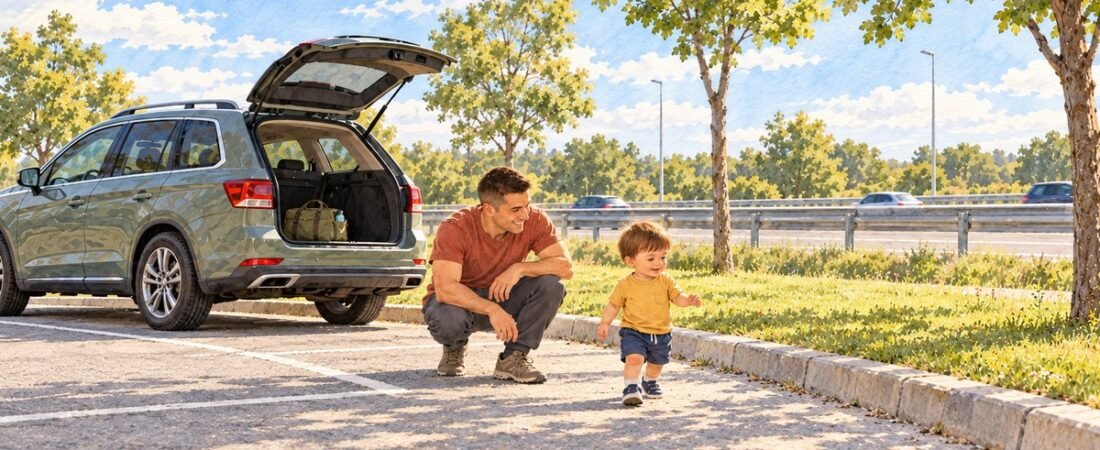
By Antonio
A five-hour road trip with a toddler is one thing. Doing it alone, with an 18-month-old and nobody beside you to help, is another. But, it’s doable.
Before the trip, I spent time thinking about how I was going to keep my son reasonably happy while still focusing on driving. I read other parents’ experiences, including plenty of Reddit threads, and came up with a simple plan; sort of a Frankenstein of everything I read. Instead of looking for one activity that could entertain him for hours, I would cycle through lots of smaller things that might each buy me another few minutes.
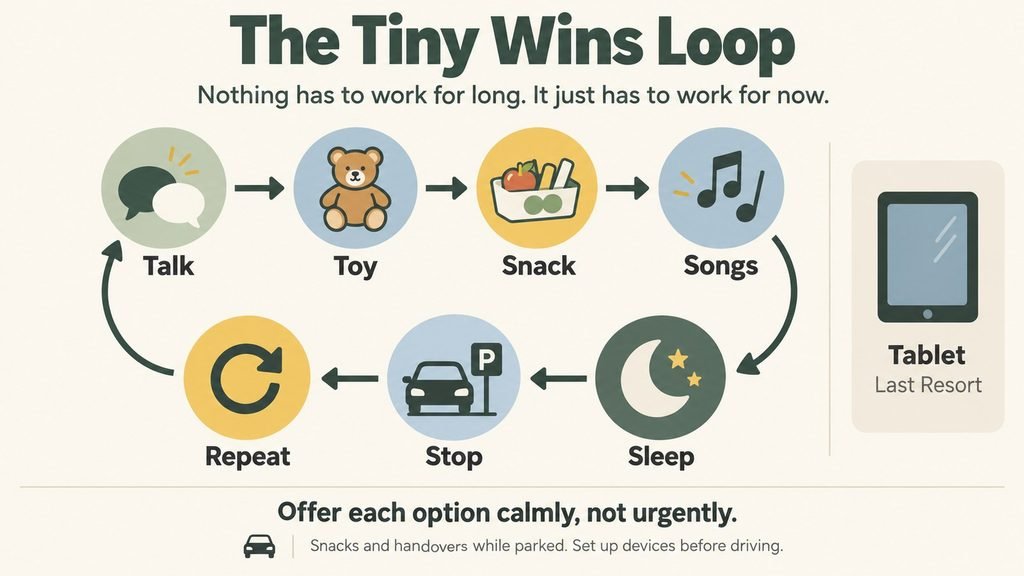
Looking back, I think of it as the Tiny Wins Loop. Nothing had to work for very long. It just had to work for now.
And despite one very questionable rest stop and a fairly spectacular meltdown near the end, it worked well. Here’s my story.
My 5-Hour Road Trip With a Toddler, in Short
Safety note: This is what I did on our trip, not universal child-passenger advice. My son was secured rear-facing in his car seat. Always follow your local laws and the instructions for your specific child seat and vehicle. Anything that requires more than a simple, safe action from the driver should wait until the car is parked.
My plan was a DIY ladder of distractions.
None of those things needed to entertain him for an hour. If a cheap toy occupied him for five minutes, that was five useful minutes. If food got us through another 15 or 20, even better. The goal wasn’t to create five hours of perfect toddler entertainment; it was to keep moving from one manageable stretch to the next until enough of those little stretches added up to the whole journey.
 Our road trip, in small wins
Drag the car or tap a stop.
A calm rotation of little distractions. When something worked, I let it work.
But, for this to work, I had to prepare my car.
How I Prepared the Car Before We Left
Because I was driving alone, I knew I couldn’t spend the trip digging through bags, opening packages or trying to remember where I’d put something. So before leaving, I actually sat in the parked car and worked out where everything needed to go.
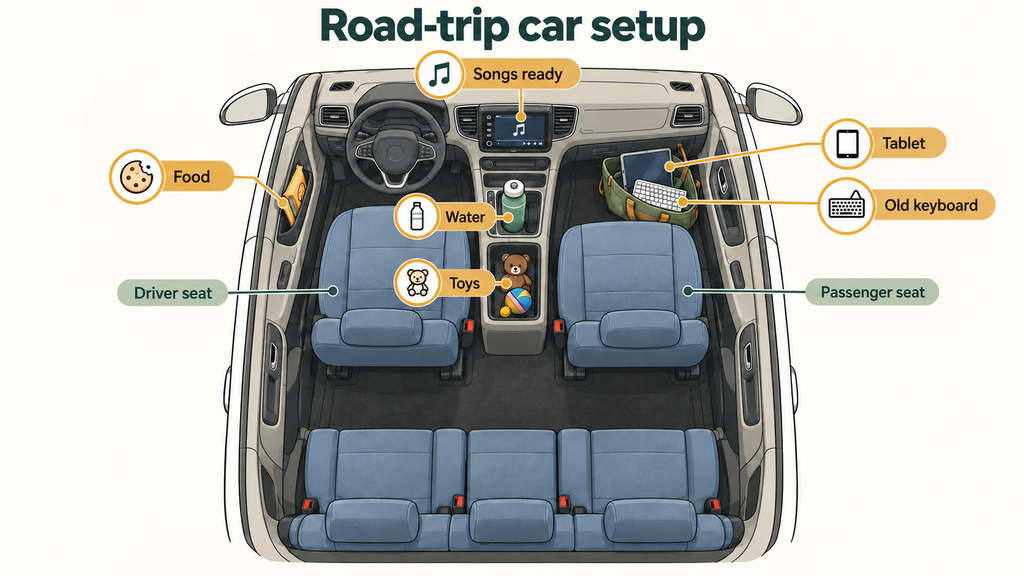
Cookies went into the driver-side door compartment. Water and the small toys went into the center storage area, and his favorite songs were already queued through the car stereo. That little rehearsal was probably one of the smarter things I did, because I wasn’t just packing a bag and assuming I’d figure things out later. I was checking whether I could access the things I expected to use without turning the drive itself into a scavenger hunt.
I also brought an old computer keyboard because my son loved pressing the keys and I didn’t care if he destroyed it. It worked as entertainment, although I wouldn’t make a heavy loose object like that a recommendation for other parents. For travel, I’d stick to lightweight, age-appropriate toys that can be safely secured or handed over.
Since I didn’t take a picture back then. Here’s a sensible illustration of how my car looked from the driver’s perspective based on what I remember. Not perfect and I used AI, but hey, better this than nothing.
The forbidden dark arts of screen time
I had a tablet ready with videos I already knew he liked, but it wasn’t mounted or playing when we started. I wanted it available as the final backup rather than something we depended on.
During our halfway stop, I installed the holder and got everything ready just in case. That mattered later because, once I needed the tablet, there was nothing left to search for, download or configure. It was ready to use.
The Tiny Wins Loop
The biggest thing I learned from the trip was that I didn’t need an activity capable of entertaining an 18-month-old for hours. What I needed was a collection of things that could work for five minutes here, ten minutes there and maybe twenty minutes if I got lucky.
Just as important, though, was the way I offered those things. I didn’t want to turn the drive into a frantic stream of questions: Do you want this? What about this? Food? Songs? Another toy?
Instead, I tried to keep the whole process calm. If he was getting restless, I might ask whether he wanted a toy. If he didn’t, that was fine. I’d leave it alone for a bit and try something else later. If something did catch his attention, I stopped offering alternatives and let him stay with it until he was bored.
That calm pacing made a big difference. The idea was essentially: here’s an option; if you want it, great, and if not, we’ll keep going.
That was the Tiny Wins Loop in practice: offer something calmly, let it work for however long it works, then move on to the next thing.
Toddler Road Trip Activities That Actually Worked for Us
I didn’t buy expensive travel toys. One of the most useful ideas I found while researching the trip was on Reddit: buy several cheap little fidget toys and introduce them one at a time. You can check Reddit for more ideas if you’d like.
So that’s what I did. I bought around five and probably spent roughly $1-$3 on each. They were simply things an 18-month-old could manipulate — spinning, clicking, snapping and making little noises. One was a Lilo & Stitch fidget-style toy with different clicking and clacking parts.
They weren’t sophisticated, and that was kind of the point.
Cheap toys only needed to work for a few minutes
I might give him one toy and get five minutes out of it. Once he was done, I’d put it away and offer another. Five minutes doesn’t sound impressive until you’re the person behind the wheel watching those little blocks slowly add up.
I’m not expecting anything to entertain a toddler for an hour. I just want enough variety to keep the cycle going. Naturally, if you find the golden goose of a toy, let me know. I’m all up for it.
Talking was an activity too
Before handing him something, I’d also try to talk to him. If he was content listening or interacting with me, there was no reason to interrupt that by producing another distraction.
One of my rules became: if something is working, let it work.
I wasn’t rotating activities according to a schedule. If he latched onto something, he kept it until he was clearly finished, and only then did I try the next thing.
Food bought considerably more time
Once the toys stopped being interesting, food became another part of the cycle. I packed familiar foods that weren’t particularly messy: things like rice cakes, cookies, sliced apple and water in one of those bottles so he can’t spill it all over my car.
Food bought me more time than a toy, sometimes around 20 minutes. At one point during the second half of the trip, my son stopped really eating the rice cakes and started tearing them apart and throwing the pieces around the car instead.
That was clearly not their intended purpose, but he was happy. The rice cakes were dry and easy to clean, so I decided this wasn’t the battle I needed to fight. At that point, the snack had become an activity.
That became another small lesson from the trip: I cared much less about whether something was being used the “right” way and much more about whether he was content and we could keep going.
Toddlers can choke on food, however, so I wouldn’t treat the specific foods I used as a universal recommendation for eating in the car. Use foods appropriate for your own child, and if something doesn’t feel safe while you’re the only adult driving, stop.
Familiar songs came next
Once toys and food had run their course, I had another easy option waiting: music.
Before the trip, I’d prepared a playlist of children’s songs he already knew and liked, including the usual familiar baby songs such as If You’re Happy and You Know It. I deliberately wasn’t experimenting with new entertainment. A five-hour drive wasn’t when I wanted to discover whether he liked something.
Eventually, somewhere in that cycle of talking, toys, food and songs, the thing I was really waiting for happened: he fell asleep.
I Didn’t Plan the Drive Around His Nap — But I Would Now
I had read before the trip that timing a long drive around your toddler’s nap could make things easier. What I couldn’t figure out was what “timing it around the nap” actually meant in practice.
Should I leave when he normally sleeps? An hour earlier? Would it be better if he fell asleep immediately, or should I try to get some awake driving time first so the nap covered more of the middle?
I wasn’t sure, so I didn’t deliberately optimize it. We left at around noon, and his normal nap was somewhere around 1–2 p.m. After we’d been driving for a while and gone through the first round of entertainment, he naturally fell asleep.
That gave me somewhere around an hour to an hour and a half of peaceful driving, which was easily the easiest stretch of the trip.
Looking back, nap timing is one of the few things I’d change. I’d probably start driving before his usual nap so the beginning of the trip is still fresh and interesting, then hopefully let the nap absorb a meaningful portion of the middle.
I wouldn’t expect the same timing to work for every toddler. But knowing my own son’s routine now, I’d make his nap part of the plan instead of letting it happen by accident.
Our Halfway Stop Didn’t Go According to Plan
After he woke up, we were somewhere around the middle of the journey, which was perfect timing for our planned stop. Unfortunately, this was also where one part of my preparation completely fell apart.
Before leaving, I’d asked AI to suggest a good place to stop on my route. The recommended place supposedly had a playground, which sounded perfect after spending hours in a car seat.
Except when we arrived, there was no playground. There was basically a parking lot.
So instead of relaxing while my toddler played somewhere contained, I spent the break following an 18-month-old around a parking area and making sure he stayed somewhere safe. He still got a chance to move around, which helped. We bought some more food, and somehow I even managed to have a coffee.
Then came the next challenge: putting him back into the car seat.
From his perspective, he’d finally escaped the car. He’d been released, stretched his legs and regained his freedom, and now I was telling him we were going straight back in. He was understandably unimpressed.
If I repeated the trip, I’d still schedule a substantial halfway break. I’d just verify the stopping point myself first. I don’t need an incredible attraction; a real playground, grassy area or somewhere an energetic toddler can safely move around would be enough.
The lesson wasn’t really “don’t trust AI.” It was more basic than that: if an important part of your road-trip plan depends on something being there, verify that it’s actually there.
The Second Half Was the Hardest
Once we were back in the car, I didn’t come up with a clever new strategy. I simply restarted the Tiny Wins Loop.
Maybe he wanted a toy. If not, I’d wait and offer something else later. Maybe food worked. Maybe songs did. Whenever he became genuinely interested in something, I stopped trying to entertain him and let that thing run its course.
I think the calmness mattered almost as much as the options themselves. There was no benefit in sounding increasingly desperate every time he rejected something. If he said no, that was fine. We’d keep driving and try something else when it made sense.
The second half was still harder than the first. By this point he’d already played with the toys, eaten, listened to songs and slept, so the novelty of the whole experience was wearing thin. Even so, the cycle kept us moving.
That’s probably the main thing I’d tell another parent preparing for a long car ride with a toddler: don’t judge an activity by whether it works for a long time. Five minutes is useful, ten minutes is useful and twenty minutes is fantastic. Enough tiny wins eventually become a five-hour journey.
The Tablet Was My Last Resort
Then we reached the final stretch. There were roughly 45 minutes left, and my son had reached his limit.
This wasn’t mild boredom anymore. He was done.
The toys weren’t working, food wasn’t enough and the songs had lost their magic. So I finally reached for the forbidden spell: the screen.
I’m not 100% against screen time. But more on that in another blog post. In this case, I just didn’t want to use one for the entire journey if I could avoid it, which is why I’d kept it in reserve.
During our stop, I’d mounted it and made sure everything was ready. I already had familiar baby-song cartoons prepared, mostly the same songs he already enjoyed listening to, so when I needed the tablet there was nothing for me to set up while driving.
For that final part of the journey, it did what I needed it to do.
Why I’d still save the tablet until later
This wasn’t about proving I could do a five-hour road trip without screens (it was, but just a bit). But I wanted to keep as many options available as possible.
If we’d started with the tablet, then four hours later I might have had nothing novel left when he genuinely reached his breaking point. By holding it back, I still had something different to offer when everything else had run its course.
I’d use the same approach again: start with the simplest options and keep the strongest backup for when I actually need it.
What I’d Do Differently Next Time
Surprisingly, there isn’t much I’d completely change because the basic system worked. There are really only two things I’d improve.
1. I’d plan the trip around his nap more deliberately
Leaving at noon happened to work fairly well because his nap naturally arrived around 1–2 p.m., but that was more luck than planning.
Now I’d intentionally try to leave before his nap so we could use the first stretch for talking and activities and hopefully let sleep cover a large chunk of the middle.
2. I’d verify the stop myself
I would absolutely plan another halfway break. I just wouldn’t arrive expecting a toddler playground and discover a parking lot instead.
I’d check recent photos, maps, reviews or official information before choosing the place where I expected my toddler to get out and burn off some energy.
Other than that, I’d genuinely use the same system again.
My Simple Toddler Road Trip Checklist
If I were preparing for the trip again, I’d bring several cheap, lightweight fidget-style toys, one or two familiar objects I already knew he liked, suitable food and water, a playlist of songs he’d heard before, and a tablet with familiar content ready as a backup.
I’d also plan a real stop somewhere around the middle and, where practical, position the drive around his normal nap.
Most importantly, I’d sit in the driver’s seat while the car was parked and physically test the whole setup again. I’d make sure I could access what I needed without digging through bags, that the music was ready, that nothing important was likely to slide somewhere unreachable, and that anything requiring assembly or setup had already been dealt with.
The less I need to think about any of that once we’re moving, the better.
Road Trip With a 2-Year-Old: Would I Use the Same Plan Now?
My son was about 18 months old when we made this trip. He’s two now, and yes, I’d still use essentially the same strategy.
The specific toys would change. He understands more now, communicates more and can stay interested in some things for longer, but I still wouldn’t build a five-hour road trip around one activity.
I’d still think in phases and tiny wins: talk, play, music, break, hopefully sleep, then introduce something different when boredom starts setting in. I’d also still keep one reliable backup for the point where he’s simply had enough.
If you’re looking for more things your toddler might enjoy once you’re out of the car, I also have a full collection of activities for 2-year-olds and quiet activities for toddlers.
The Biggest Thing I Learned From a 5-Hour Road Trip With a Toddler
Before the drive, I was asking myself the wrong question: how am I going to keep an 18-month-old happy for five hours?
Almost nothing is going to do that.
The much more useful question was: what can get us through the next five or ten minutes?
A toy doesn’t need to be amazing. A song doesn’t need to work forever. Food doesn’t need to occupy half the journey. You just need enough little options to keep moving from one manageable stretch to another without making the whole process frantic.
Stay calm, offer something and, if it works, leave it alone. If it doesn’t, that’s fine too. Try something else when you need to. Eventually, all those tiny wins add up, and hopefully somewhere in the middle your toddler sleeps for an hour.
If everything finally collapses with 45 minutes left, that’s why I had the tablet.
One more thing
There is one detail I’ve left out of this story: getting there wasn’t the end of the adventure.
I still had to drive the five hours back home.
A few days later, we did essentially the same journey in reverse. After everything I’d learned on the first drive, did I develop an entirely new and sophisticated road-trip system?
No. I basically used the Tiny Wins Loop again: toys, food, songs, sleep, stop, repeat, with the tablet available when necessary.
And it worked again.
That’s probably the best endorsement I can give the plan. I wouldn’t call a five-hour solo road trip with a toddler relaxing, but I’d do it again.
And next time, I’ll make sure the playground exists.
Need Something to Do When You Get There?
If you’ve finally escaped the car and your toddler somehow still has energy left, use the Little Moment Play Activity Finder to find something that fits their age, your available time and how much mess you’re willing to deal with.