By Antonio
I love board games, which means my natural instinct is to look at the rules first. That or listen to my friend who’s even more into board game explaining the rules.
Becoming a parent has made me much less convinced that reading and then executing on rules is the right first step. I learned that quickly with Rhino Hero Junior. The box said 2+, and I went into our first attempt expecting that I would explain the rules by being a cool, jolly dad. Me being a cool dad, my son would listen and we’d have a fabolous time I’d retell my friends at board gaming night. Naturally, that didn’t happen.
But, once I stopped trying to make the whole game happen at once, it became much more fun. More of the intended game started making sense later, but the thing that got him interested first was building and then tearing it down. (reason why he loves Jenga as well)
So now, when I’m considering board games for 3-year-olds, I don’t care that much about if it says 3+ on the box. It’s a good starting point, but not a validation. I want to know what the child gets to do in the first minute, how much explaining is required before something interesting happens, and whether the game still works if they only understand part of it at first.
The result is not a list of six boxes that happen to say 3+. These are six games where I can see a practical way for a young child to get interested before every rule has to make sense.
Quick Shortlist: 6 Board Games for 3-Year-Olds
| Game | Best if your child likes… | What they mainly do | Play time | Approx. US price* |
|---|---|---|---|---|
| Animal Upon Animal Junior | Stacking and building | Stack wooden animals | 10 min | $29.99 |
| Orchard | Collecting and playing together | Roll and collect fruit | 10–15 min | $44.99 |
| The Sneaky, Snacky Squirrel Game | Colors, sorting and grabbing things | Match colors and collect acorns | ~15 min | $24.99 |
| Feed the Woozle | Moving around | Carry silly food to the Woozle | ~15 min | $24.99 |
| Count Your Chickens! | Counting and repetition | Move, count and collect chicks | ~15 min | $19.99 |
| Unicorn Glitterluck: Cloud Crystals | Racing and collecting treasure | Roll, move and collect crystals | 10 min | $19.99 |
Prices checked in October 2026 and can change.

A little help choosing a game
What does your toddler enjoy?
Start by stacking two animals yourself. Let your toddler add one, build a separate tower, or knock yours down. Bring in the die once the pieces are familiar.
A clear first action. It may feel more like a stacking toy than a board game at first.
A starting point from Antonio’s shortlist, not a readiness test. Follow your toddler’s interest and the game’s age guidance.
In this article
- How I Chose These Board Games for 3-Year-Olds
- What Does “3+” Really Tell Me?
- 1. Animal Upon Animal Junior
- 2. Orchard
- 3. The Sneaky, Snacky Squirrel Game
- 4. Feed the Woozle
- 5. Count Your Chickens!
- 6. Unicorn Glitterluck: Cloud Crystals
- Cooperative or Competitive: Which Would I Start With?
- How I Introduce Board Games to Young Kids Now
- So, Which Board Game for a 3-Year-Old Would I Start With?
- How I Researched This Guide
How I Chose These Board Games for 3-Year-Olds
I didn’t want to make this list by searching for games marked 3+ and choosing the six with the nicest themes. The age on the box matters, particularly for component safety, but it tells me much less about whether a game will be enjoyable in a real first session.
Like with my other board game articles, I looked first at what the publisher says: recommended age, player count, play time, components and the basic rules. Then I looked at what the child is being asked to do once the game reaches the table. A game where the first meaningful action is stacking an animal or picking up an acorn is very different from one where the fun only appears after several minutes of explanation.
I also paid attention to the parts that product descriptions tend to skip. Can progress suddenly disappear? Does the child need to sit still? Is the game almost entirely random? Are there dozens of small components to keep track of? Does it have enough room to stay interesting after the first few plays?
None of those things makes a game good or bad. They tell me which child, family and moment it may fit. So, time to put my science/board-game goggles on.
I want an obvious way into the game
At this age, I like games where I can show the first action rather than explain the whole system. Stack the animal, grab the matching acorn, collect the fruit or feed the monster. Once a child understands why the pieces are interesting, the rest of the rules have somewhere to go.
That is one of the biggest lessons I took from playing Rhino Hero Junior with my son. I used to think teaching a game meant explaining it clearly. Now I think the first job is getting to the part that makes the child want another turn.
I want rules that can arrive gradually
As a board gamer, I enjoy rules and systems. As a parent, I don’t think that means a young child needs every rule before play begins.
If a game has special spaces, extra modes or unusual spinner results, I would rather explain those when they become relevant. A first game can be imperfect without being a failed game.
That does not mean rewriting every game until the rules no longer matter. It means asking how little information we need to start playing successfully.
The physical parts of the game matter
For adults, the mechanism may be the most interesting thing about a board game. With a young child, the components themselves can be part of the hook.
Chunky wooden fruit, animals that balance on one another or a squirrel-shaped grabbing tool create something worth exploring before the child understands scoring, winning or turn order. That makes component design a much bigger part of my decision than it would be when I’m choosing a game for adults.
I also want to know where the game may go wrong
A useful recommendation should tell me more than why something might be fun. I want to know what could end the session.
One game on this list can take away something the child has already collected. Another contains 60 small crystals. One costs almost twice as much as some of the alternatives. Another has very little decision-making.
Those are not reasons to reject them. They are reasons to choose them thoughtfully.
What Does “3+” Tell Me?
I treat the age recommendation as a useful filter, not as proof that a child should be able to play the full game independently.
Based on my research, the CDC’s milestone guidance for age three includes children noticing other children and joining them in play, along with increasingly complex language and everyday interaction. It does not define board-game readiness or say that a three-year-old should already be able to sit through a complete game, remember every rule and wait patiently through every turn.
That matters because the phrase “board games for 3-year-olds” can make it sound as though turning three unlocks a new skill overnight. I think the more useful question is whether the game offers enough structure for the adult while still giving the child an easy first action.
For me, a good game at this age gives us room to begin imperfectly. We can start with the part the child understands, add the rest as it becomes relevant, and still have something recognizable as a game.
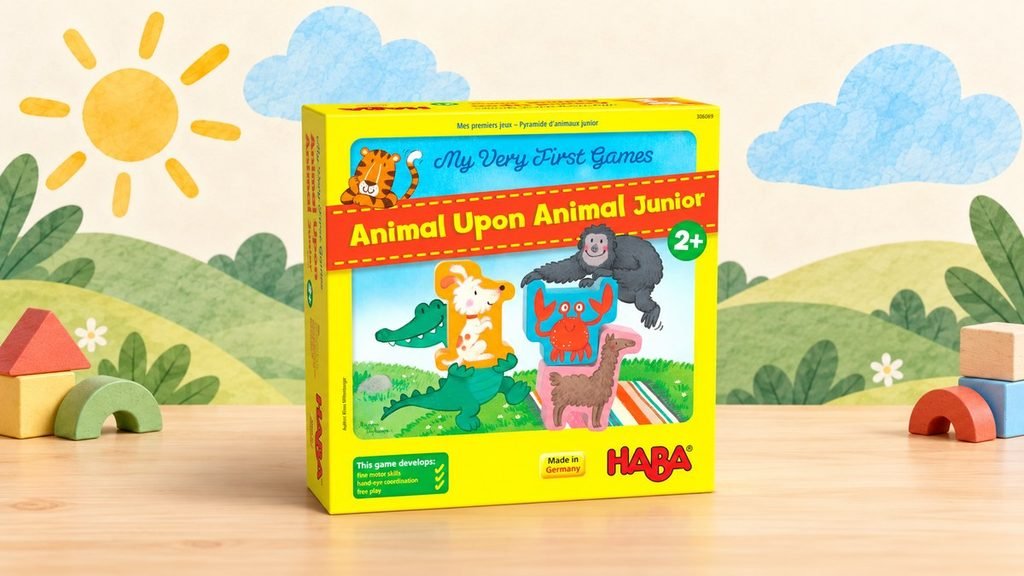
1. Animal Upon Animal Junior
Best for: Stacking and tactile play
Publisher age: 2–3 years
Players: 1–4
Typical game time: 10 minutes
Approx. price: $29.99
Animal Upon Animal Junior on HABA USA
If I had to choose the game with the easiest entry point on this list, I think it would be Animal Upon Animal Junior.
HABA includes eight wooden animals, a die and several ways to play, including two dice games and a cooperative version. The important part for me is that none of those rules has to be the first reason a child touches the game. The animals already give you something to do: stack them, see whether they stay up, watch the tower wobble and try again when it falls.
That makes this one of the clearest examples of the approach I like with young children. The physical action can come first, and the board-game structure can arrive later.
Where I’d start
I would probably put out the animals and start stacking. If the child wants to copy me, build their own tower or knock mine over, I would let that be the game for a while rather than immediately bringing out the die and explaining the different modes.
Once the animals themselves are familiar, adding a rule has a better chance of feeling like an extension of something they already enjoy rather than an instruction standing between them and the pieces.
Why it makes my shortlist
The explanation burden is extremely low, and the central action still works if the child stops caring about the official sequence of turns.
HABA positions this as a Junior game for younger children, but I also wouldn’t assume that makes it disposable after age three. Also, this is a great example where the age says 2, but I used to play this one with my nephew (who was 6 years old at the time) for hours. It says 2+, not below 2. Which is also the reason I found it enjoyable as well.
For a child who likes building, balancing and making things fall down, this would be one of my first choices.
Where I’d hesitate
If the child is already looking for clear objectives, races, choices and a winner, Animal Upon Animal Junior may feel more like a construction toy than the sort of board game they want.
That is also what makes it such an easy starting point. Whether that is a strength or a limitation depends on the child.
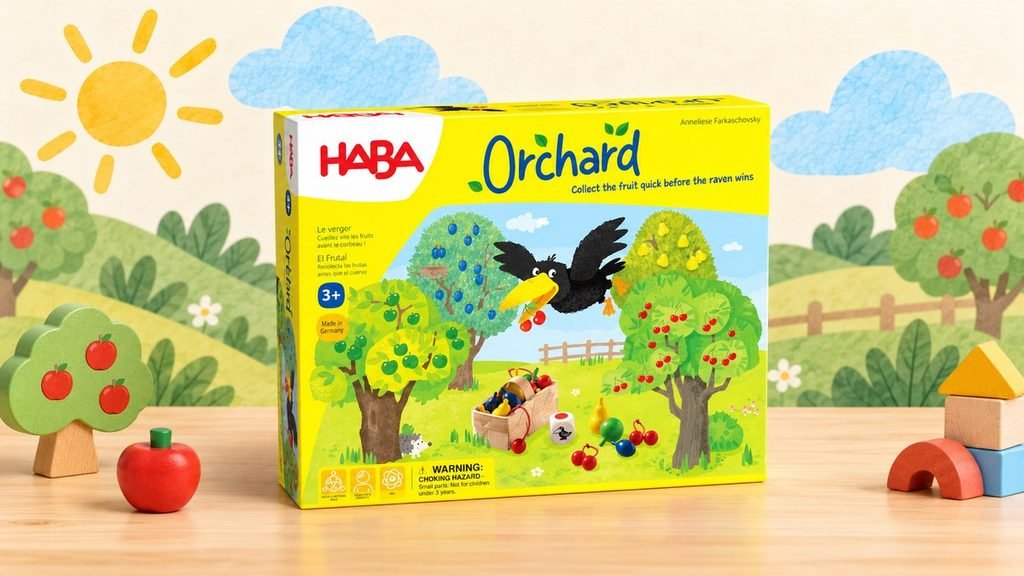
2. Orchard
Best for: A more traditional first cooperative board game
Publisher age: 3–6 years
Players: 1–8
Typical game time: 10–15 minutes
Approx. price: $44.99
Orchard is the game on this list I would look at first if I specifically wanted something that feels like a more traditional board game.
There is a board, a die, turns, a shared objective and a clear ending. Everyone tries to collect the fruit before the raven puzzle is completed. HABA lists the game for ages 3–6 and includes 40 wooden fruit pieces, baskets, a color die and the raven puzzle.
The structure is more recognizably “board game” than Animal Upon Animal Junior, but the first action is still easy to show. Roll a color, find that fruit and put it in the basket.
Where I’d start
I would explain the shared story first: we need to collect the fruit before the raven gets there.
Then I would roll.
If a color appears, we take the matching fruit. If the raven appears, that is a perfectly good time to explain what the raven does. I don’t see much value in explaining every possible die result before the child has seen any of them.
This is one of the habits I use when teaching adult board games too. Give people enough information to take the next turn, then explain exceptions when they become relevant.
Why it makes my shortlist
If someone asked me for a game that introduces the basic feel of sitting around a board, taking turns and working toward an ending, Orchard would be near the top of my list.
It is also cooperative. Nobody at the table is personally beating the child or taking the fruit away from them. Everyone is trying to finish the same job before the raven does.
I don’t think cooperative games are automatically better at this age, but they remove one possible source of friction while a child is learning what a structured game feels like.
First Orchard or Orchard?
I included First Orchard in my board-games-for-2-year-olds shortlist. Orchard feels like a natural game to look at next because it keeps the fruit-collecting theme while adding a fuller board and slightly more structure.
I would not treat that as a required progression. A child does not need to “graduate” from First Orchard before trying Orchard, and there is no reason to buy both simply because one is marketed younger.
But if First Orchard already works well in your home, Orchard is an obvious place to look when you want something a little fuller.
Where I’d hesitate
The biggest drawback is the price.
At about $44.99 when I checked, Orchard is more expensive than the other games in this guide. If I had no idea whether board games were going to become a regular activity, I might experiment with a cheaper game before spending that much.
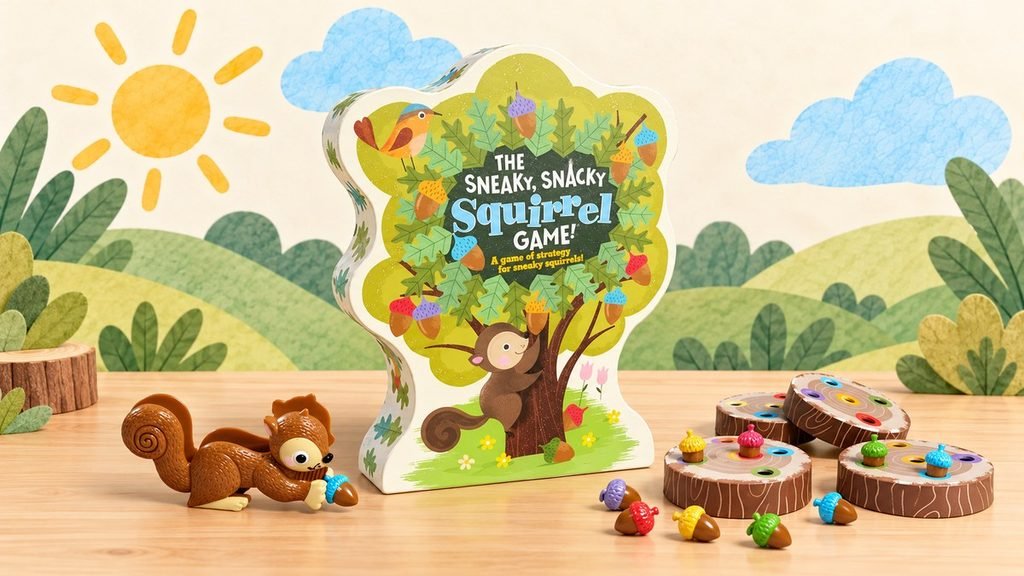
3. The Sneaky, Snacky Squirrel Game
Best for: Colors, sorting and hands-on play
Publisher age: 3+
Players: 2–4
Typical game time: about 15 minutes
Approx. price: $24.99
The Sneaky, Snacky Squirrel Game on Educational Insights
The Sneaky, Snacky Squirrel Game has one of my favorite hooks here because the most memorable component is also the thing you use to play.
Players spin the spinner, find the matching colored acorn and use a squirrel-shaped grabbing tool to move it into their log. The goal is to collect one acorn of each color. On paper, that is a simple color-matching game. On the table, I think the squirrel itself is what makes the idea much easier to sell to a child.
Where I’d start
I would show the squirrel grabbing an acorn before I explained the objective.
Then I would spin once, find the matching color and demonstrate the whole basic turn. If one of the unusual spinner results appears later, we can deal with it then.
That keeps the first explanation focused on the part the child can immediately imitate.
Why it makes my shortlist
The physical action and the game rule are tightly connected. The child is not matching colors because an adult has turned play into an educational exercise. Matching the color is simply how you know which acorn to collect.
That makes the game easy to understand without needing to dress it up with claims about what it teaches.
The competitive structure also gives it a different feel from Orchard. Everyone has their own log, and the goal is to fill yours first.
Where I’d hesitate
Some spinner results can take away progress or let another player take an acorn. For one child, that may create the kind of small drama that makes a game exciting. For another, losing an acorn they just collected may be the moment the game ends.
I would think about that before worrying about whether the child knows all the colors.
If having something taken away is currently a major frustration point, I would probably start with Orchard, Count Your Chickens or Feed the Woozle instead.
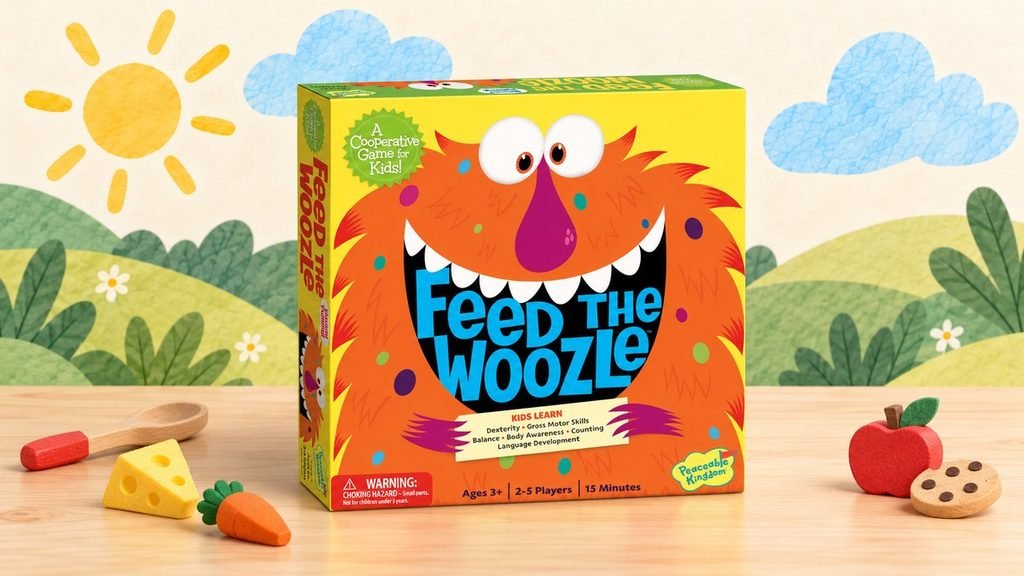
4. Feed the Woozle
Best for: A child who would rather move than sit
Publisher age: 3+
Players: 2–5
Typical game time: about 15 minutes
Approx. price: $24.99
Feed the Woozle earns its place because it solves a different problem from almost everything else here: the child does not have to stay seated for the game to work.
Players cooperate to feed the Woozle a collection of silly foods, carrying the pieces on a spoon. The game includes three levels, so the basic physical idea can stay the same while more structure is added later.
For a child who sees a chair as something to leave as quickly as possible, that difference matters.
Where I’d start
I would begin with the simplest level and keep the first explanation around one idea: get the food to the Woozle.
There is no reason to explain every difficulty level just because the box contains them. Let the child become familiar with the spoon, the food and the idea of feeding the monster first.
If that becomes easy, the extra rules give the game somewhere to go.
Why it makes my shortlist
Movement is not something the adult has to keep correcting. Movement is part of playing properly.
That gives Feed the Woozle a very different place in this list from Orchard or Count Your Chickens. If sitting around a board is the thing making games difficult, changing the game may work better than repeatedly asking the child to sit down.
I also like the three-level structure because it gives the box an explicit way to become more challenging without changing the central idea.
Where I’d hesitate
The same movement that makes Feed the Woozle appealing also means it is not the game I would pick when I want something calm.
It needs more space than a normal tabletop game, and the mood is deliberately silly and physical. If I were choosing something for a quiet end to the day, another game would fit better.
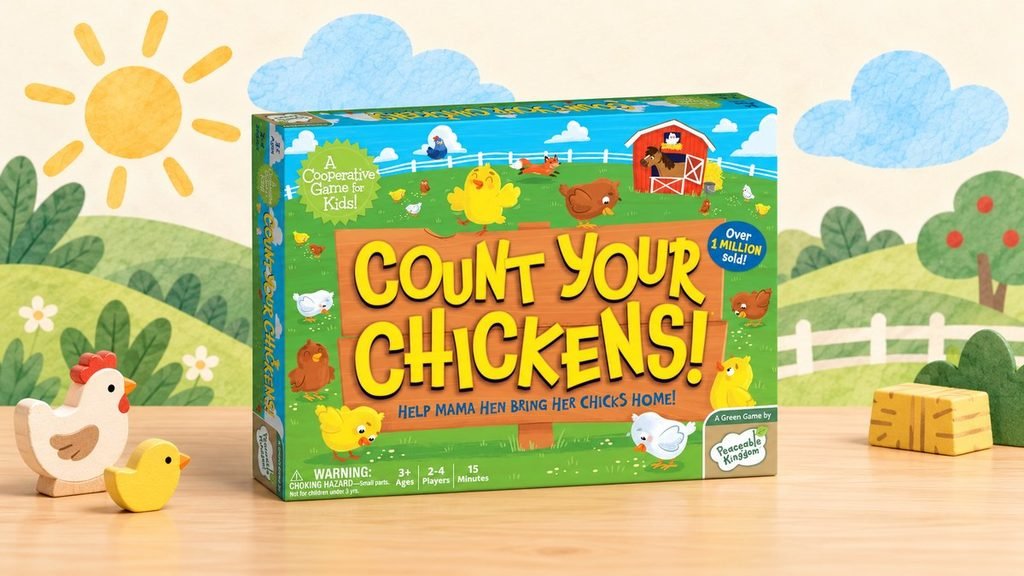
5. Count Your Chickens!
Best for: Counting and a very simple cooperative game
Publisher age: 3+
Players: 2–4
Typical game time: about 15 minutes
Approx. price: $19.99
Count Your Chickens is probably the simplest traditional board game in this group.
Everyone helps Mother Hen collect her chicks and return them to the coop. Players spin, move along the board, count the spaces travelled and add that many chicks to the shared coop. There is a repeated rhythm to the game that should become familiar fairly quickly.
Where I’d start
I would lead with the story rather than the counting.
The chicks got out. We need to help Mother Hen bring them home.
Then we spin and move together. If the child needs help counting the spaces, I would count with them rather than turning the game into a test of whether they can do it alone.
Counting is useful here because it is part of the action the game already requires, not because I need to convince myself that playing a board game has to become a lesson.
Why it makes my shortlist
The structure is extremely simple, the goal is shared and there are very few decisions to explain.
That can be a limitation for an adult board gamer, but at this age I think it can also be the reason to choose it. A child can focus on the repeated sequence of spinning, moving and collecting without also needing to think through several options.
If what you want is an uncomplicated introduction to taking turns around a board, that simplicity has value.
Where I’d hesitate
There is not much strategy here.
If the child already wants to make choices and think about what to do next, Count Your Chickens may feel repetitive sooner than some of the other games. I would choose it because I wanted something simple, not because I expected it to grow into a deeper game later.
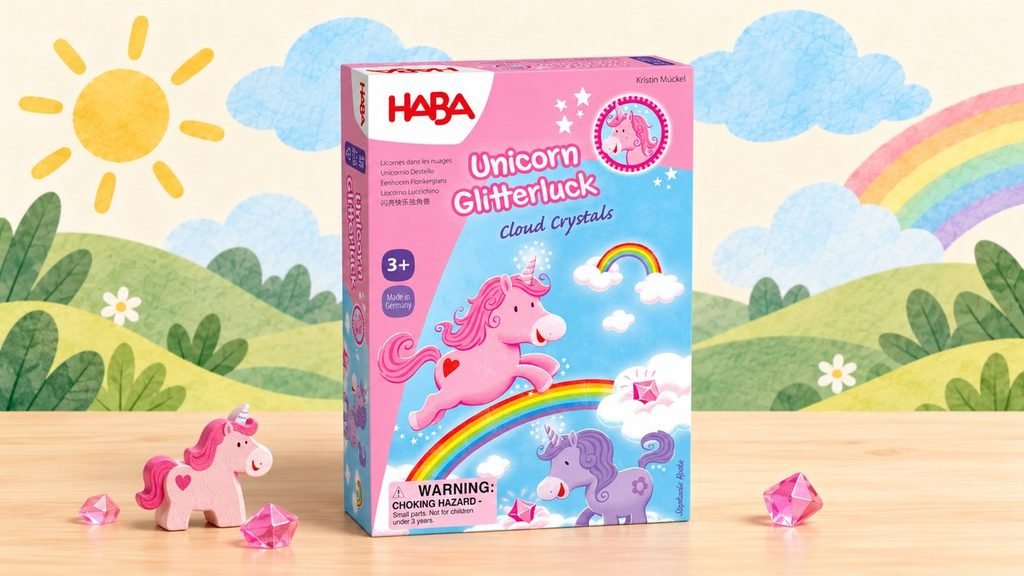
6. Unicorn Glitterluck: Cloud Crystals
Best for: A simple competitive race
Publisher age: 3+
Players: 2–4
Typical game time: 10 minutes
Approx. price: $19.99
Unicorn Glitterluck: Cloud Crystals on HABA USA
I deliberately wanted one straightforward competitive game in this shortlist.
Unicorn Glitterluck gives each player a unicorn, sends them across the clouds and has them collect crystals along the way. At the end, the player with the most crystals wins.
That makes it different from Orchard, Feed the Woozle and Count Your Chickens, where everyone is working toward the same result.
Where I’d start
I would begin with the basic rhythm of rolling, moving the unicorn and collecting crystals.
When a special space appears, that is when I would explain what it does. I would not introduce every board symbol before the first turn simply because the information exists.
For me, this is another example of teaching only what the player needs right now.
Why it makes my shortlist
I don’t want to create the impression that cooperative games are the only sensible option for a three-year-old.
Some children enjoy races. Some like collecting more of something than the other player. Some become more interested when there is a clear winner.
If that makes the game more exciting instead of making losing overwhelming, a simple competitive game can be a perfectly reasonable choice.
Where I’d hesitate
The box contains 60 cloud crystals, which is the first practical thing I would think about in a home with younger siblings or a child who still puts small objects in their mouth.
The other caveat is for the adults. Mechanically, this is a very light roll-and-move game with a lot of luck. If I wanted interesting decisions for myself too, this would not be my first choice.
If I wanted a ten-minute race with unicorns and treasure, the simplicity would be part of the appeal.
Cooperative or Competitive: Which Would I Start With?
I don’t think there is a single right answer. Same as I don’t have a preference with my buddies. We play all kinds of board games. The important thing is to have fun.
A cooperative game removes one obvious complication because the child is not losing to the adult. In Orchard, Count Your Chickens and Feed the Woozle, everyone is trying to accomplish the same thing. If the game beats you, it beats everybody.
That can make the first few board-game experiences simpler, especially when the child is already trying to understand turns, rules and the idea that an activity has a defined ending.
Competitive games add another layer. Sneaky Snacky Squirrel can take away progress, and Unicorn Glitterluck ends with one player having more crystals than the others. For some children that may become the only thing they care about. For others, the race is what makes the game interesting in the first place.
I would not choose based on the idea that cooperation is developmentally better or that a child needs to learn how to lose. I would choose the structure that makes playing together easier right now.
How I Introduce Board Games to Young Kids Now
My approach to children’s board games changed quite a bit after that first Rhino Hero Junior attempt.
I think teaching the game means getting the child to the interesting part with as little unnecessary explanation as possible.
That usually starts with finding the thing the child already has a reason to care about. With Animal Upon Animal, that is stacking. With Sneaky Snacky Squirrel, it is grabbing an acorn. With Feed the Woozle, it is carrying something ridiculous across the room to feed a monster.
Once that part works, I can begin attaching rules to it.
I also demonstrate much more than I explain. Taking one turn and saying, “I rolled red, so I take a red fruit,” usually gives the child more useful information than describing the entire turn structure before anything has happened.
The same goes for special rules. If we have not landed on the special space yet, I probably do not need to explain it. I would rather pause for ten seconds later than front-load several rules that may not matter for another five minutes.
I also no longer care much if the first game is messy. If we miss something small, I am not going to stop every thirty seconds to correct it unless the mistake makes the game stop working. There will be plenty of time for the proper version if the child wants to play again.
And if they stop wanting to play, I stop.
A ten-minute game can still be too long on the wrong day. Finishing the board is much less important to me than ending while the experience is still mostly positive.
So, Which Board Game for a 3-Year-Old Would I Start With?
If I knew nothing about the child except their age, I would probably narrow the first choice to Animal Upon Animal Junior or Orchard, but for different reasons.
Animal Upon Animal Junior has the lowest barrier to entry. A child can enjoy the central action before the game structure means anything, and the rules can grow around something they already understand.
Orchard would be my choice if I specifically wanted a more traditional board-game experience. It gives you turns, a board, a shared goal and a clear ending without requiring much strategic thought or reading.
After that, I would follow the child’s interests. Feed the Woozle is the obvious option for someone who wants to move. Sneaky Snacky Squirrel makes sense for a child fascinated by colors, sorting and picking things up. Count Your Chickens suits the child who already enjoys counting things for fun, while Unicorn Glitterluck is the clearest choice if races and having a winner make a game more exciting.
The common thread is the same thing I learned from Rhino Hero Junior at home: I wouldn’t start with all the rules. I’d start with the part of the game the child already has a reason to care about, then let the rest of the game earn its way in.
How I Researched This Guide
I approached this guide from two directions.
As a parent, I care about things that rarely make it onto the front of a box: how much explanation happens before anything fun, whether the child needs to sit still, whether losing progress could end the session, whether the pieces make sense in a real home and whether stopping halfway still leaves the experience feeling worthwhile.
As a board gamer, I look at the structure underneath the theme. I want to know what happens on a turn, how repetitive the game is, whether the player makes meaningful choices, how easy the game is to teach and whether there is enough variation to make me want to bring it out again.
For factual information, I used official publisher pages and rule materials where available to verify recommended ages, player counts, typical play times, components and how each game works. For the broader context around age three, I used authoritative developmental guidance only to keep the article grounded. I did not use developmental milestones as a board-game-readiness test or to rank the games.
I also looked at parent and board-game community experiences where they helped reveal practical issues that product descriptions often miss. I treat those as experiences, not proof that a game will work the same way for every child.
The distinction I tried to preserve throughout the guide is simple: what the publisher says, what the rules require, and what I think of the game as a parent and board gamer are three different things.
Keeping them separate is what makes the recommendations useful.
Need Something to Do Right Now?
If you’re unsure what fits right now, use the Activity Finder for one suggestion based on age, time, setup and mess.